Water Without a Steward: How Pipes, Corruption and an 80–200% Tariff Jump Turn Co-Owners of a Territorial Community into Powerless Payers
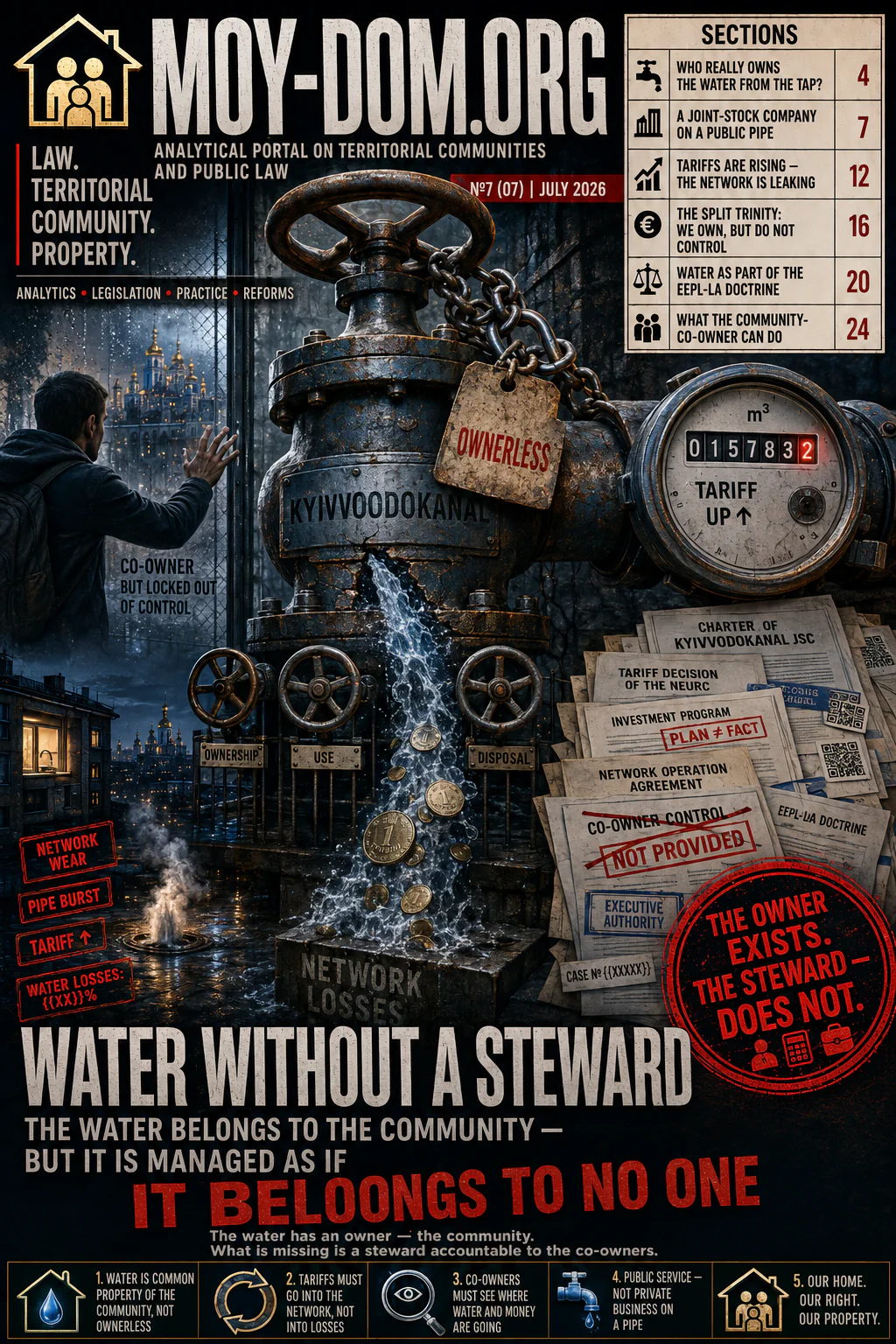
Water Without a Steward: How Pipes, Corruption and an 80–200% Tariff Jump Turn Co-Owners of a Territorial Community into Powerless Payers
The water supply crisis has three faces — worn-out pipes, a corruption “feeding trough” and tariff shock. Each is discussed separately, yet together they add up to a single diagnosis: our water has no steward. First the full picture of the problem, without softening. Only then the worked-out way out.
Author: Viacheslav Morgun, Ph.D in Law — specialist in municipal and constitutional law and economics, author of the SLEPL-EE model (“Sole Legal Entity of Public Law — Economic Entity”). Works on utilities and municipal finance from primary sources. About the author →
The short version
- In the autumn of 2025 a single main outside Lviv burst four times in a row over three days: patched, then split again. Around 50,000 people were left without water, and no missile had anything to do with it. Across the country the networks are 60–70% worn out, and water losses reach 40%.
- Leaks are not only lost money: water washes out soil and undermines foundations and roads. In Kyiv, burst mains have already opened sinkholes that swallowed asphalt and a car. A worn-out pipe is a safety hazard, not a budget line.
- Even the money that exists often fails to reach the pipes: the former head of Kyivvodokanal is suspected of misappropriating almost UAH 65 million, and four cases in total have gone to court against nine officials with combined damages of UAH 67.7 million. The supervisory board of Mykolaivvodokanal is maintained at roughly UAH 177,500 a month — and two of its five members failed to file asset declarations, which triggered a criminal case.
- From June 2026, after Law No. 4777-IX devolved tariff-setting to territorial communities, water tariffs rose by 80–200%: Pavlohrad — UAH 113 per cubic metre, Vinnytsia — 81, Ternopil — around 100, Uman — over 130. Often for water that, as people put it, “you cannot drink, let alone wash in”. The course towards “market prices” is also backed by the IMF: its roadmap covers gas and electricity directly — and those two form the backbone of the cost of a cubic metre. Although there is no market here: water, heat, gas and power are network monopolies, not competitive goods like cars or phones.
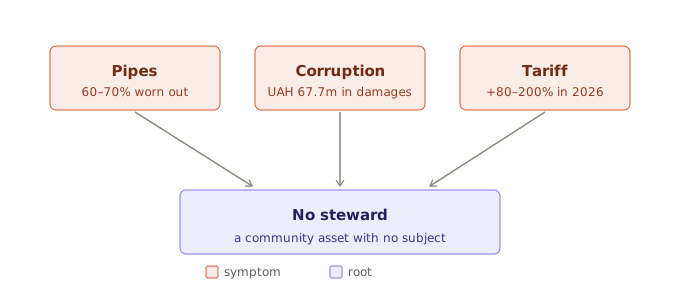
- The three faces — pipes, corruption, tariff — are one diagnosis: the missing steward. In the “LSG + MUE” model everyone is responsible for the asset a little, which means no one is.
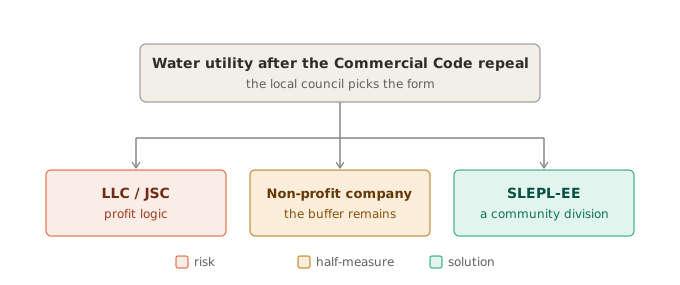
- The repeal of the Commercial Code opened a window: until 2028 municipal water utilities may become an LLC, a JSC or a municipal non-profit company — by decision of the local council. That is either a deepening of commercialisation or a chance to give the water a single steward back.
- The alternative is worked out: the water utility as an inseparable division of the single property complex of the territorial community (the In-House model); a price set at cost, with depreciation and investment but without private margin; continuous owner control by the territorial community instead of external supervision — all of this is the SLEPL-EE doctrine.
Introduction
On 23 October 2025 the main carrying water into Lviv failed. It was patched — and the pipe burst again. And again. And again. Four bursts on one line over three days. Around 50,000 people without water, a tenth of the city; courtyards were served by water tankers.
Not a single strike. Not a single Shahed. Just an old pipe that had gone unattended for years — and repairs that only ever kept pace with the next failure.
Remember that detail, because it breaks the usual optics. When we hear “a threat to critical infrastructure” we habitually look at the sky — missiles, strikes on the Bortnychi treatment plant, blackouts. The threat is real. But the data of 2025–2026 says something uncomfortable: water supply is collapsing above all not because of shelling. Unlike the power sector, where most failures follow strikes by the eastern neighbour, the “quiet infrastructure” of water utilities rots on its own. From worn-out networks. From decades of deferred repairs.
Ukrainian cities, as the Association of Water Utilities put it precisely, live on “the water loan of the past”. While the water still runs underground, the debt is invisible. Let one main fail — and within three days the city is on the edge of paralysis.
That statement sounds harsh, so it should be proved rather than merely proclaimed. The crisis has three faces — pipes, corruption, tariff. Below we first set out each of them in full, without softening, and show that these are not three separate misfortunes but one diagnosis (Figure 1). And only then: honestly about the limits of that diagnosis, about how we got here, and about the way out that has long been worked out in the academic literature.
Why this concerns everyone
A water utility is not “some enterprise somewhere in the city”. It is the common property of the territorial community. And a territorial community is not an abstraction: it is you, your neighbours, all the residents of a city or village together. Under Articles 5 and 7 of the Constitution of Ukraine local self-government is recognised and guaranteed, and the territorial community is the primary bearer of authority locally; pipes, pumping stations and treatment works are part of the material basis of local self-government (Article 142), the constitutional foundations of which the author examined back in his 2022 monograph.
Legally, every resident is a co-owner of this property. Not a “customer”, not “the population”, not a “subscriber”, but a co-owner entitled to know, to decide and to control. It is precisely this status that gives the territorial community the right to stop a water utility from being quietly disposed of, to demand accounts and audits, to block a questionable decision. And it is precisely this status that is being eroded today — by the tariff, by corruption, and by the very construction in which water flows “from somewhere” rather than from your common asset.
So that this does not remain an abstraction, let us follow the fate of an ordinary city water utility — an old Soviet inheritance, worn-out networks, a tariff that barely covers costs — through all three faces of the crisis.
Face one: pipes half a century old
Let us start with a figure that ought to hang in every mayor’s office. To replace one emergency line in Lviv in full costs more than UAH 2 billion. The city’s entire annual budget is UAH 15 billion. In other words, one street underground costs an eighth of everything the city has for a year. No household tariff will close that gap — worth keeping in mind when we get to tariffs.
And now the whole country at a glance. Kyiv: 4,200 km of pipes, 60–65% past their service life, around 35% of the water leaking into the ground on the way to the tap; 15 km are replaced per year — while failures already run at 6,400 annually. Lviv is 70% worn out and patches 30–35 km of the hundreds needed. Odesa is also close to 70%, with losses up to 40%; the EBRD-funded reconstruction of the Suvorovskyi collector is a quarter done. Poltava loses 41% of its water on the way, replaces 10–12 km a year, has already recorded more than 90 sewer collapses — and in the spring of 2025 warned of scheduled water supply. And on 3 November 2023 Zhytomyr shut off water to the entire city — as a planned measure, to repair one pressure collector. For a few hours. But the very possibility of leaving a regional capital without water “because of one pipe” is itself the diagnosis (Figure 2).
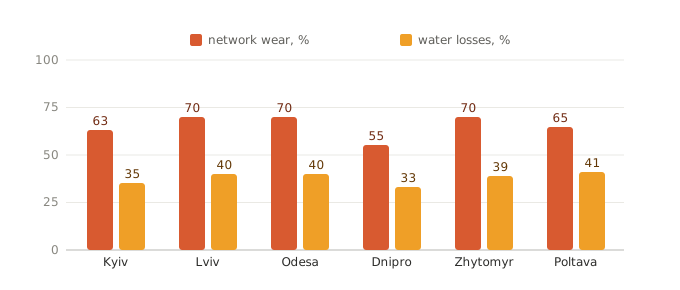
The pattern is single: pipes age faster than they are replaced. And every year the city sinks deeper into debt.
And here is what hides behind the dry “percentage of losses”: it is not only money that has drained into the ground. Water seeping out from under the asphalt for years washes out the soil — and then roads collapse and foundations are undermined. In Kyiv this is already routine: on Verkhovna Rada Boulevard a burst 600 mm main opened a sinkhole; in the Holosiivskyi district a car partly fell through undermined asphalt; builders record cracks and collapses near foundations caused by prolonged sewer leaks. Among the documented hazards of worn-out networks are the destruction of buildings and bridges and the washing away of roads and railways. So the “percentage of losses” on your bill is in fact the holes that open where people were driving a moment ago. A worn-out pipe threatens more than the budget — it threatens life. And the longer repairs are deferred, the closer the next failure moves from “inconvenience” to catastrophe.
According to estimates by the industry association of water utilities published in the autumn of 2025, at 70% of small enterprises consumption rose by 10–25% because of displaced people, while more than 65% of the networks should long since have gone for scrap. There is no money for capital repairs — so patching remains. This is not a series of unfortunate coincidences in different cities. It is a single process of deterioration that the war and the movement of people merely brought into the light.
Face two: the “feeding trough” with a criminal case
Now — why even the money that exists fails to reach the pipes.
The former director general of Kyivvodokanal has been served with a notice of suspicion: according to the investigation, he and accomplices misappropriated almost UAH 65 million during the battle for the capital — ostensibly for relocating a floating pumping station to the Desna (Article 191(5) of the Criminal Code, up to twelve years). That is one case. Alongside it, four more proceedings have gone to court against nine officials — from department heads to Kyiv City State Administration officials and contractors — where established damages amounted to UAH 67.7 million. There are no verdicts in these cases so far; the presumption of innocence applies. But the sum alone is dozens of kilometres of new networks. Precisely the ones that are missing.
Mykolaiv is a different genre, the same disease. The supervisory board of Mykolaivvodokanal — five people — is maintained at the enterprise’s own expense at roughly UAH 177,500 a month (the chair on 39,500; the rest on 34,500 each). And in May 2026 a criminal case was opened over undeclared assets: two of the five members of that same board had failed to file (no notices of suspicion have been served so far). And here it is worth saying plainly: on this logic a supervisory board is created not to put things in order but to provide cover — to defuse public discontent through the mere appearance of control. Behind the façade of “independent directors” the institution meant to guard the property becomes the subject of proceedings itself — and this at a loss-making enterprise. The imitation of supervision costs the territorial community dearly — and it does not replace a real steward.
Isolated bad actors? Convenient, but inaccurate. Industry experts put it more harshly: a water utility is a “feeding trough” for local authorities. And that is not abuse but a description of the mechanics. What the author’s doctrine calls the capture of territorial communities — a local version of “state capture”, described in article 2026a — is visible here in almost laboratory-pure form. A municipal enterprise as a separate legal entity becomes a convenient buffer: into it flow both the payers’ money and the responsibility — to dissolve there quietly. Opaque procurement, supervisory boards “for trading on one’s face”, “dead souls” on the payroll — these are symptoms of one thing. The territorial community’s asset is disposed of as though it belonged to no one.
Face three: the tariff tripled. The water did not
And onto this construction — worn-out pipes plus the feeding trough — the tariff shock of 2026 now lands (the scale of the jump is in Figure 3).
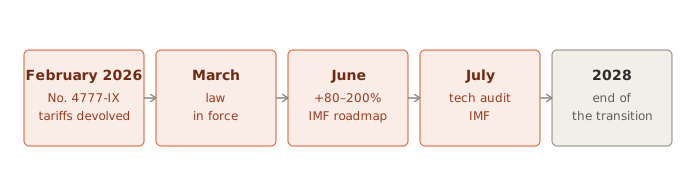
The trigger is purely legal. Law No. 4777-IX of 10 February 2026 — a large “omnibus” on energy markets, in force since 11 March — devolved, through one of its provisions, the power to set water tariffs from the NEURC to local self-government bodies (for the duration of martial law and one year after it). In practice the mechanism started working in May, after the corresponding NEURC resolution — and the first local tariffs apply from 1 June. For four years the state had “frozen” tariffs. And the moment it handed the wheel to territorial communities, catching up began: a wave of increases of 80–100%, and in places threefold, that is up to +200%. Already approved: Pavlohrad — UAH 113 per cubic metre, Drohobych — 87, Voznesensk — 71, Zaporizhzhia — 69, Chernivtsi — around 64. Not yet approved but already announced: Vinnytsia — 81, Ternopil — around 100, and in Uman more than 130 is forecast.
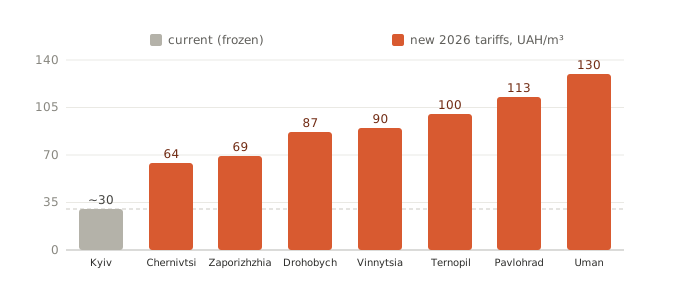
The reasons the enterprises give are real: electricity (three times more expensive for business), reagents, fuel, repairs. But here is the twist.
The tariff triples — while the water in the tap often stays such that, as the experts themselves say, “you cannot drink it, let alone wash in it”.
The payer is driven into a corner: either an empty tap or a full bill for a poor service. A criterion suggests itself here, one the European Court of Human Rights formulated as far back as Sporrong and Lönnroth v. Sweden: interference with property rights must strike a “fair balance” and must not place a disproportionate individual burden on a particular person. When the price is tripled and the quality left as it was, the balance is plainly not on the payer’s side.
The “cost plus” methodology itself — the higher the costs, the higher the tariff — reproduces the trap the Soviet Kosygin–Liberman reform of 1965 fell into: having changed the indicators, it never broke the cost-driven mechanism — saving remained unprofitable, because the reward was attached to volume rather than to efficiency (the author draws this comparison in the article “The Energy Trap”). Performed by the feeding trough, it means a simple thing: the bill carries both the objective cost and the consequences of mismanagement. And here is the key point: the tariff is raised without changing the model of economic management itself. The money is there. The pipes leak.
The common denominator: water without a steward
Let us put the puzzle together. Pipes burst because nothing was invested for years. The money does not arrive because part of it is eaten by capture. The tariff soars because it is being asked to cover the cost and to compensate for mismanagement at the same time — and all of this without changing the model of economic management.
The common denominator is one: there is no single responsible steward.
The author examines the mechanics of this in detail in article 2026v: ownership is split — the territorial community keeps the nominal title and the burden of upkeep, while real disposal slips out of its hands. When “everyone a little” is responsible for an asset — the state, the city, a separate enterprise, a supervisory board, a balance holder — then no one is responsible for it. The model the author critically calls “LSG + MUE” (a local self-government body plus a municipal unitary enterprise as a separate legal entity) does not distribute responsibility. It disperses it.
And the worst of it: in this model water belongs to you not as a co-owner but is slipped to you as a “service” — billed, and switched off for three days “for repairs”. This is exactly the illusion of the service state — a paradigm analysed in article 2026g. The state pretends it is “providing a service”, while in fact shifting the entire risk and the entire burden onto the individual. This is clearest not even in water but in subsidies: to confirm eligibility a pensioner has to pass a video verification; add hundreds of villages without stable connectivity and a 70-year-old who lives 50–100 kilometres from the district centre — and the “service” turns into risk and burden resting wholly on the “customer”.
The threat now ripening: the choice being made right now
One might object: the disease is old, so why bring in the calendar? Because on 28 August 2025, when Law No. 4196-IX entered into force, the Commercial Code ceased to have effect. The construction “a municipal enterprise as an economic entity”, on which the “LSG + MUE” model rested, lost its support. The transition period runs to 28 August 2028, and the government approved the procedures for converting enterprises into the new forms back in September 2025: a joint-stock company (JSC), a limited liability company (LLC), or a non-profit company — a state non-profit company for state enterprises, a municipal non-profit company for municipal ones.
An important detail: for municipal enterprises this is not compulsion but a choice — the decision is taken by the local council. And that is precisely where the risk lies. The simplest path is to re-register the water utility as an LLC or a JSC and move on with the logic of a commercial firm, which by its nature gravitates towards profitability, that is towards the tariff as the main source of the company’s “health”. The author separately warns about the constitutional risks of such civilistic expansion in article 2026d. A municipal non-profit company looks like the softer option — it is non-profit and holds property under a usufruct — but it too leaves the water utility a separate legal entity acting as a buffer, detached from the territorial community (Figure 4).
And here is something worth noting separately. The usufruct — a new property right that the same Law No. 4196-IX introduced in place of the right of economic management and operative administration — is granted not only to companies but also to local self-government bodies themselves. In other words, the new construction of holding does not stand in the way of the single-steward model. What remains superfluous within it is precisely the intermediate legal entity.
This choice is also overlaid on a hard timeline of pressure on the tariff — from the devolution of powers to territorial communities to the IMF’s requirements (Figure 5).
Put simply: the threat is not in a forced deadline but in the choice. By 2028 hundreds of councils will be deciding the fate of their water utilities — and in the absence of a better model they will by default pick the “LLC sign” hung over the same feeding trough. This is exactly the moment to stop patching the model and choose a different one. But first — honestly about the limits of what has been said.
Honestly about the limits of the diagnosis
Comparisons and diagnoses are a powerful instrument, and it is easy to abuse. So let us be precise.
First, not every tariff increase is theft. Electricity for enterprises really has tripled in price, as have reagents and fuel; four years of an artificial tariff freeze objectively drove water utilities into a financial hole. As of 1 May 2026 the overdue debt of Ternopilvodokanal alone to the Ministry of Finance on World Bank loans reached USD 5.9 million — almost UAH 260 million, more than 60% of the enterprise’s annual revenue — and the immediate trigger was precisely the rise in the price of electricity. Part of the increase is an honest reflection of cost, not the appetite of the feeding trough.
Second, the war really has increased the load: the inflow of displaced people added 10–25% of consumption in cities, on networks not designed for it. Blaming everything on mismanagement would be dishonest.
Third, there are positive examples too — international donors (NEFCO in Poltava, the EBRD in Odesa, Denmark in Lviv) show that money for modernisation can be raised. The question is who disposes of it and under what rules.
Fourth, the tariff is driven not only by the local feeding trough but also by macro-policy. Under the updated memorandum with the IMF published at the end of July 2026, the government is to draw up a roadmap for the transition to market prices for gas and electricity and to lift the moratorium on raising prices for gas, heating and hot water. This roadmap does not cover water directly — and that should be said honestly. But electricity and heating are precisely what forms the backbone of the cost of a cubic metre, so the pressure on the water tariff will come from there anyway, on the second lap, without any separate decision about water. Here comes a fundamental caveat. There is no “market” in these services at all. A market is where you can choose a different seller: cars, phones, coffee. Water, heating, gas and power are network monopolies: there is one pipe to the building, one wire, and no competition in principle. The price here is formed not by the balance of supply and demand but by the “wish lists” of monopolists, approved through lobbying at the regulator (the author examines this “great illusion of the market” in the article “The Energy Trap”, and the legal regime of such services — SGEI — in article 2025b). That is precisely why life support — water, heating, energy — should not be a “market” but the common economy of the territorial community, with a price set at cost (cost plus depreciation and investment, without margin). And one more thing. However many audits are ordered from above, without a change of model they will yield nothing: an audit will certify only the paperwork — that the figures in one set of documents match those in another. It will not see the real state of the pipes underground or the real movement of money behind those papers.
But acknowledging these nuances does not cancel the diagnosis. It merely refines it: the problem cannot be reduced to the war, or to a lack of money, or to creditors’ demands, or even to the absence of an audit. Money appears — and disappears. The war sharpens things — but the pipes were rotting before it. The root is institutional: it lies in the model of economic management itself.
How we got here
The argument “we have no steward of the water” carries more weight if one recalls that territorial communities were methodically deprived of a steward.
What was called “decentralisation” in Ukraine between 2014 and 2020 was not decentralisation. To see this one needs a criterion — and the reform was never tested against the constitutional criterion of what makes decentralisation decentralisation at all. It was measured by surrogates: how much local budgets grew, how many territorial communities were formed, how many functions were “handed down to the local level”. Yet not one of these indicators says the main thing — whether the territorial community became an autonomous subject determining its own competence.
The constitutional criterion is different. Under Article 5 the people exercise power through two systems — the state one and the self-governing one; the total volume of that power is constant, and only the proportion between them changes. Then decentralisation is a shift of the boundary in favour of the self-governing part, and recentralisation is the reverse movement. From this follows a conclusion that turns everything around: even growth in budgets and functions is not decentralisation if the autonomy of the territorial community narrows at the same time. And narrow it did: the new territorial basis of communities in 2020 was formed not by the territorial communities themselves but by the Cabinet of Ministers, by orders from above; a law on local referendums has still not been adopted; and the moment the competence of a territorial community is reduced to a list of the “permitted”, a teleological subject is turned into a limited object of administration. That is the marker of recentralisation — even under the banner of reform. (The author develops this constitutional criterion in a separate work on genuine decentralisation; the institutional risks to the autonomy of the territorial community in legislative initiatives are analysed in article 2025a, and the mechanics of the splitting of ownership in article 2026v.)
The water utility crisis is a direct continuation of that movement. First territorial communities were stripped of part of their control. Now, through the tariff, corruption and the transformation of municipal enterprises into LLCs and JSCs, they are being stripped of what remains of their co-owner status. Two steps of one process. And that is exactly why patching pipes will not stop it — the subject has to be restored.
Is there an alternative? Yes
Criticising is always easier than proposing, so let me say it plainly: the alternative exists, and it has been worked out in the academic literature. Its integral form is the SLEPL-EE doctrine (“Sole Legal Entity of Public Law — Economic Entity”, canonically grounded in article 2025b).
Despite the cumbersome name, the idea is simple. A territorial community is a single indivisible subject of public law, founded on public property and public finances, which runs its economy directly, through its own inseparable structural divisions, rather than through dozens of detached “subsidiary” legal entities. Instead of fragmenting the single property of the territorial community into a multitude of enterprises and “companies”, each of which can be bankrupted or disposed of separately, the territorial community operates as one public institution, directly accountable to its resident co-owners. This is the same logic of direct provision (In-House) whose boundaries the Court of Justice of the EU outlined in Teckal — we shall return to it. Let us test the model for strength against the same three faces (a comparison of the two models is in Figure 6).
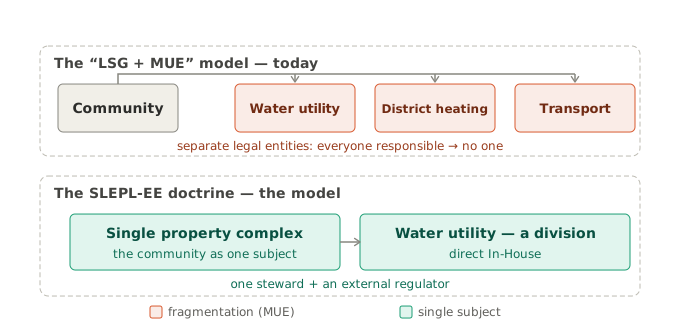
Against the feeding trough — remove the buffer. The separate legal entity inside which responsibility dissolves disappears. No “municipal enterprise as a firm” — no room for supervisory boards “for trading on one’s face”, for procurement between the territorial community and “its own” enterprise, for loss-making that obliges no one to anything. The water utility becomes a division of the territorial community with direct accountability. (Even the softer form — a municipal non-profit company — leaves the water utility a separate legal entity; the doctrine removes the buffer itself.)
Against tariff shock — a different yardstick. Instead of “cost plus”, pricing on the cost recovery principle, developed in article 2026b: the tariff covers actual operating expenditure, builds depreciation reserves and an investment component for renewing the networks — but without a margin for a private owner, and any surplus is reinvested in the service. Where the cost is objectively higher than ability to pay, there is state compensation (which, unlike in Poland or Austria, is exactly what we lack). Because critical infrastructure produces not profit but public value (public value versus shareholder value — the dichotomy from articles 2026a and 2026b): health, sanitary safety, continuity. Measuring it by the margin on a cubic metre is like assessing a fire station by its revenue. The criterion here is different — social return on investment (SROI).
Against worn-out pipes — a fund and scale. “There is no money for the roof” stops being a verdict if network renewal is tied to a dedicated Capital Repair Fund (article 2026b) with a statutory ban on non-personalised accounts — so that money for pipes cannot be “dissolved”. It is filled not by a miracle: by the depreciation component of the tariff, which is not dissolved in current turnover; by the surplus reinvested instead of going into dividends; by a targeted subvention under the principle of strict fiscal correspondence — when the state sets a new standard, it is obliged to provide the money for it; and by donor loans, which are easier to raise for a single responsible manager than for a buffer enterprise with shaky reporting (NEFCO and the EBRD already work exactly this way). And so as not to keep fifteen accountants in every small town, small water utilities are logically consolidated into regional ones — as in Germany, the Netherlands and Britain. And here it is important not to confuse concepts. At the basis of decentralisation lies the autonomy of the territorial community, and at the basis of autonomy lies economic autonomy: its own, capable material and financial foundation, the constitutional underpinning of which the author examined back in his 2022 monograph. Without its own property and money, “autonomy” remains a declaration. So consolidating the water utility into the single property complex of the territorial community is not the “fragmentation of the pipe” people are warned about (water cannot be fragmented, nor is there any need), but the very shift of the boundary in favour of the territorial community discussed above: the return to it of the status of a real steward and manager. And SLEPL-EE is precisely the institutional form in which decentralisation becomes genuine.
What to do right now
Since decisions on the form of water utilities are being taken right now, the practical implications are these:
- local councils — do not rush into re-registering as an LLC or JSC “by default”; consider the single property complex model, and treat a municipal non-profit company as a transitional rather than a final option;
- do not reduce the matter to an audit: on its own it merely records the state of affairs on paper. First a change in the model of economic management (a single property complex, direct In-House), and only within it transparent accounting and continuous owner control;
- residents — use your status as a co-owner: demand publication of procurement, repair plans and reports, rather than silently accepting the new bill.
Honestly about the weak points of the doctrine
It would be dishonest to present SLEPL-EE as a magic wand. Opponents put the strongest counterargument first: by removing separate legal entities, will we not kill accountability and end up with an unwieldy monopolist free of external control?
The answer is decisive — and it does not come down to “trust the territorial community”. Accountability is secured not by an external supervisor but by continuous owner control — by the territorial community itself and its co-owners. For this the doctrine has built-in instruments (article 2026b): two-tier verification of works (the V-Model) by technical services together with bodies of self-organisation of the population; the right of suspensive veto of such bodies, under which an acceptance certificate is not considered accepted and is not paid without the electronic signature of the body’s head; a Community Impact Statement, which rules out disposal behind closed doors; and parity audit with the participation of co-owners. This is a fundamentally different logic from a supervisory board at UAH 177,000 a month in which two of five members failed to file declarations: the latter is an imitation of control from outside, the former is inseparable owner control from within. Discipline is provided not by a regulator or an “independent director” but by a steward who watches over their own property continuously.
The second objection strikes even closer. Fine, you have removed the buffer — but you have handed the water utility directly to the very city authorities you yourself accuse of capturing the community. Is that not the same feeding trough, only without the intermediate sign?
The objection is fair — and that is exactly why the doctrine does not stop at “remove the municipal enterprise”. The difference is that the legal partition behind which responsibility used to dissolve disappears. In the “LSG + MUE” model the mayor says “that is the enterprise’s economic activity”, the director says “that is the founder’s decision”, the supervisory board says “we only supervise”: by the very construction there is no one to hold responsible. When the water utility is a division of the territorial community, property, money and responsibility lie within a single loop, and alongside it stand the co-owner’s instruments — the suspensive veto, parity audit, the Community Impact Statement. A feeding trough lives not off the form of ownership but off opacity and impunity; the doctrine strikes precisely at those.
The third objection is purely practical, and it is the one that most often decides the fate of a reform. A separate legal entity exists not only to hide responsibility: it also limits it. By removing the municipal enterprise, will we not simply shift a water utility’s loss-making year onto kindergartens and hospitals?
The doctrine’s answer is the Economic Risk Fund (article 2025b, developed in 2026b and 2026v): commercial risks are legally separated from the social budget within the single property complex, without creating a new legal entity. The fiscal screen stays in place; only the partition behind which responsibility used to hide disappears.
And what about European practice?
Here EU law works even better than the doctrine requires. The Court of Justice formulated the “in-house” exception in Teckal (C-107/98, 1999) for cases where a contracting authority buys a service from a formally separate legal entity that it controls as though it were its own division. Later, in Stadt Halle (C-26/03, 2005) and Parking Brixen (C-458/03, 2005), the Court narrowed that exception: any participation of private capital destroys it, and a concession, even outside the directive, is bound to observe transparency and non-discrimination. But our model has no need to invoke that exception at all: where the water utility is an inseparable division of the territorial community itself, there are no two persons and no contract — so no subject matter for a tender arises in principle. The doctrine is not looking for a loophole in procurement law; it simply remains outside its scope.
The real price of the transition is purely organisational: reassigning assets and retraining people. But the comparison should not be with an ideal, but with the real alternative: re-registering water utilities as LLCs and JSCs, “cost plus” without compensation, a tariff of UAH 80–130 for water you cannot wash in. Against that background, the model of a single responsible steward is not a utopia but a more honest framework, and one more compatible with EU law.
Conclusions
One Lviv pipe burst four times in three days — and not a single missile. That is the whole point. We have grown used to looking for the threat to our water from outside, in the sky. The main one has long been underfoot: pipes nothing was invested in; money the feeding trough ate; a tariff with which both are being patched. And all of it rests on a single emptiness — on the missing steward. And that neglect is dangerous not only for the budget: sinkholes under roads and undermined foundations make it a direct threat to people.
The SLEPL-EE doctrine will not fill the pipes with water by itself, nor find two billion overnight for the Lviv line. But it asks the right question. Not “how much more will the population pay”, but “who is responsible for an asset whose co-owners are the residents”. And it gives an institutional answer: a single steward, direct In-House, a price set at cost (with depreciation and investment), a fund for repairs — and continuous owner control by the territorial community, rather than a resident cast as a “customer” with an empty tap.
The window opened by the repeal of the Commercial Code closes in 2028, and councils are choosing the form right now. By then we shall either give the water a steward back — a single responsible territorial community that watches over its own property — or simply hang an “LLC” sign over the feeding trough. And then every next burst pipe will not be a failure. It will be another instalment on the water loan we never repaid.
📩 I explain utilities in plain language. How to read your tariff, check your water utility and scrutinise municipal deals — grounded in statutes and primary sources.
Subscribe: Telegram. No spam, unsubscribe any time.
Frequently asked questions (FAQ)
Why did water tariffs rise sharply in 2026?
The trigger is legal: Law No. 4777-IX (adopted on 10 February, in force since 11 March 2026) transferred tariff-setting from the NEURC to local councils — and after four years of a freeze, sharp catching up began: from 1 June 2026 prices rose by 80–100%, and in places threefold, that is up to +200%. But the root goes deeper. After the repeal of the Commercial Code, municipal water utilities are being re-registered as LLCs or JSCs by 2028, and a commercial firm by its nature gravitates towards profitability — towards the tariff as the main source of the company’s “health”. The price is raised without changing the model of economic management itself — so the tariff grows and the problem remains.
Who sets water tariffs now?
The local council: since March 2026 the power to set tariffs for centralised water supply and wastewater services has been transferred to local self-government bodies — for the duration of martial law and one year after its termination. The NEURC retains licensing and the review of justification, but the decision on price is taken by the territorial community through its own bodies.
Why does the tariff grow while water quality does not?
Because the price is raised without changing the model of economic management. The “cost plus” methodology applies — the higher the costs, the higher the tariff: the same trap the Soviet Kosygin–Liberman reform of 1965 fell into, which never broke the cost-driven mechanism, since saving is unprofitable when the reward is attached to the volume of expenditure rather than to efficiency. The bill carries both the cost and the consequences of mismanagement, so the tariff triples while the water in the tap often stays such that “you cannot drink it, let alone wash in it”. Even an audit will yield little here: it certifies the paperwork, not the real state of the pipes underground. The money is there — the pipes leak.
Who is responsible for the water utility in a city?
Legally — the territorial community as co-owner. But in the “LSG + MUE” model (the city plus a municipal enterprise as a separate legal entity) responsibility is dispersed among everyone — that is, in practice, rests with no one.
What will happen to water utilities after the repeal of the Commercial Code?
By 28 August 2028 the local council must choose a form: an LLC, a JSC, a municipal non-profit company — or make the water utility an inseparable division of the territorial community under the SLEPL-EE model.
What is the SLEPL-EE model in plain words?
The territorial community runs its economy as one indivisible subject of public law — directly, through its own divisions, rather than through dozens of separate municipal-enterprise buffers. The price is formed on the cost recovery principle: the tariff covers operating expenditure, depreciation and investment in renewing the networks, but without a margin for a private owner, and any surplus is reinvested in the service. Repairs come from a dedicated Capital Repair Fund; the resident is a co-owner, not a “customer”. More detail — the SLEPL-EE explainer.
Sources and the doctrinal basis of the research
This article is a long-form account of the author’s research. Numerical data are given according to media reports and official sources and were verified as of 30 July 2026 (tariff data as of June 2026). They reflect the moment of publication and require re-verification against primary documents before academic use.
Legislation
- Constitution of Ukraine of 28 June 1996 (Articles 5, 7, 19, 140, 142) — zakon.rada.gov.ua.
- Law of Ukraine No. 4196-IX “On the specifics of regulating the activity of legal entities of certain organisational and legal forms in the transition period…”: the Commercial Code ceased to have effect on 28.08.2025, with a transition period to 28.08.2028; enterprises convert into a JSC, an LLC or a non-profit company (a state non-profit company for state enterprises, a municipal non-profit company for municipal ones), and for municipal enterprises by decision of the local council. The same law introduced a usufruct over state and municipal property in place of the right of economic management and operative administration. The conversion procedures were approved by Cabinet of Ministers resolutions in September 2025 (in particular No. 1102 of 09.09.2025). Overview: infobox.prozorro.org; Ministry of Justice clarification: news.dtkt.ua; usufruct: Association of Ukrainian Cities, just-dnipro.gov.ua; procedures: kmu.gov.ua, YURLIGA.
- Law of Ukraine of 10.02.2026 No. 4777-IX (the omnibus on the functioning of energy markets; in force since 11.03.2026) — one of its provisions transferred the power to set tariffs for centralised water supply and wastewater services to local self-government bodies for the duration of martial law and 12 months after its termination. Text: zakon.rada.gov.ua; how the mechanism applies: biz.ligazakon.net.
- Law of Ukraine “On Local Self-Government in Ukraine”; the Budget Code of Ukraine; the Tax Code of Ukraine; Law of Ukraine “On the NEURC” No. 1540-VIII — zakon.rada.gov.ua.
- European Charter of Local Self-Government (Strasbourg, 15.10.1985; ratified by Law No. 452/97-VR of 15.07.1997), Articles 4 and 9.
Case law and comparative context
- European Court of Human Rights. Sporrong and Lönnroth v. Sweden, applications nos. 7151/75, 7152/75, judgment of 23 September 1982 — the “fair balance” and “disproportionate individual burden” criteria under Article 1 of Protocol No. 1. Text: BAILII.
- Court of Justice of the EU. Teckal Srl, Case C-107/98, judgment of 18 November 1999 — the formulation of the “in-house” exception (two criteria: control analogous to that over its own departments, and the carrying out of the essential part of the activity for the contracting authority). Text: EUR-Lex.
- Court of Justice of the EU. Stadt Halle, Case C-26/03, judgment of 11 January 2005; Parking Brixen, Case C-458/03, judgment of 13 October 2005 — narrowing of the exception: the participation of private capital excludes it; a concession outside the directive is subject to the principles of transparency and non-discrimination. Texts: EUR-Lex (C-458/03); case-law digest: Tribunal de Contas, EU Public Procurement Audit Guideline.
- Comparative models: Germany (öffentliche Sachen; Eigenbetrieb, Anstalt des öffentlichen Rechts); Poland (zakład budżetowy; the gmina council’s consent to disposal); Austria (water utilities in public ownership); the Netherlands and the United Kingdom (consolidation into regional operators).
- Historical context: the Kosygin–Liberman reform of 1965 (indicators of sales, profit and delivery fulfilment) did not break the cost-driven mechanism — the author himself draws the comparison with the “cost plus” methodology in the article “The Energy Trap: Returning to Communities”.
Media and official sources
- The failure outside Lviv, October 2025 (four bursts on one line on 23–25.10; about 50,000 people without water; the cost of replacing the line more than UAH 2bn against a city budget of ~UAH 15bn): blog of Lviv deputy mayor A. Moskalenko — ZAXID.NET; dailylviv.com.
- The state of the networks, wear and losses (Kyiv, Lviv, Odesa, Zhytomyr, Poltava): Focus (10.11.2025). Sewer collector collapses in Poltava: poltava.to (16.03.2026). Zhytomyr, 03.11.2023 (planned city-wide water shutdown due to a pressure collector failure): RBC-Ukraine.
- NEURC — current tariffs and the division of powers between the NEURC and local self-government bodies.
- New tariffs of June 2026 (approved: Pavlohrad 113.00; Drohobych 87.30; Voznesensk 71.44; Zaporizhzhia 69.37; Chernivtsi 63.56; calculated and announced: Vinnytsia 81.01; Ternopil ~99; Uman 130+): RBC-Ukraine (10.06.2026); week.ukrainianwall.com (11.06.2026).
- Proceedings at Kyivvodokanal: notice of suspicion to the former head (almost UAH 65m, Article 191(5) of the Criminal Code) — Ukrinform; four cases against nine officials, damages of UAH 67.7m — Ukrinform (15.05.2024).
- The supervisory board of Mykolaivvodokanal (5 members, UAH 177,500 per month: chair 39,500, the rest 34,500 each): korabelov.info (17.04.2026); proceedings under Article 366-3 of the Criminal Code over undeclared assets by two board members (May 2026): nikvesti.com (09.06.2026).
- The updated memorandum with the IMF (July 2026): a roadmap for the transition to market prices for gas and electricity, and the lifting of the moratorium on raising prices for gas, heating and hot water — 5.ua, ZAXID.NET, Ekonomichna Pravda.
- Sinkholes and soil erosion caused by water main bursts in Kyiv: Verkhovna Rada Boulevard, Ø600 mm, December 2025 — RBC-Ukraine; Holosiivskyi district, Ø500 mm, September 2024, a car partly fell through the asphalt — LB.ua, Ukrinform.
- The debt of Ternopilvodokanal to the Ministry of Finance on World Bank loans (USD 5.9m ≈ UAH 260m as of 01.05.2026): gazeta-misto.te.ua (02.06.2026). The NEFCO grant to Poltavavodokanal (€6m): poltava.to.
Doctrinal basis — the author’s academic work
- Morgun V.V. Three Dimensions of Law: Substantiating the Three-Sector Model of Legal Entities // Bulletin of Mariupol State University. Law Series. 2025. Iss. 30. P. 138–149. DOI: 10.34079/2518-1319-2025-15-30-138-149 — the canonical definition of SLEPL-EE, the three-sector model, the Economic Risk Fund, the SGEI regime.
- Morgun V.V. Institutional Risks to the Autonomy of the Territorial Community: a Comparative Legal Analysis of Legislative Initiatives // Nashe Pravo. 2025. No. 4. P. 195–201. DOI: 10.71404/NP.2025.4.26.
- Morgun V.V. The Privatisation of Public Functions… // Yevropeiski Perspektyvy. 2026. No. 1. P. 261–269. DOI: 10.71404/EP.2026.1.33 — public value vs shareholder value; the capture of territorial communities.
- Morgun V.V. The Transformation of the Municipal Legal Status of the Resident and of Bodies of Self-Organisation of the Population… // Pravo.ua. 2026. No. 1. P. 315–324. DOI: 10.71404/LAW.UA.2026.1.42 — cost recovery, the Capital Repair Fund, the V-Model, the right of suspensive veto, the Community Impact Statement, SROI.
- Morgun V.V. The Quasi-Nationalisation of Municipal Property in Ukraine // Nashe Pravo. 2026. No. 2. P. 19–27. DOI: 10.71404/NP.2026.2.3 — the splitting of the triad of ownership powers; the autonomy of the territorial community.
- Morgun V.V. From the Illusion of the “Service State” to the Reality of a “Community of Co-Owners”: a Critical Analysis of the Social Services Reform and an Institutional Alternative // Bulletin of Mariupol State University. Law Series. 2026. Iss. 31. P. 236–246. URL: visnyk.mu.edu.ua — a critique of the “service state”. (DOI 10.34079/2518-1319-2026-16-31-236-246 did not yet resolve as of 30.07.2026 — verify before publication.)
- Morgun V.V. Constitutional Risks of Civilistic Expansion and the Institutional Alternative of SLEPL-EE… // Yevropeiski Perspektyvy. 2026. No. 2. P. 5–13. DOI: 10.71404/EP.2026.2-2.1 — the risks of converting municipal enterprises into private-law forms.
- Morgun V.V. Constitutional and Legal Framework for the Material and Financial Foundations of Local Self-Government. Kyiv: KNT, 2022. 220 pp.
- Morgun V.V. (long-form journalism). The Energy Trap: Returning to Communities. moy-dom.org — on the absence of a “market” in network monopolies, the communal nature of life support, and the Kosygin–Liberman reform.
- Morgun V.V. Genuine Decentralisation as a Constitutional Category and its Implementation in the SLEPL-EE Doctrine (work in preparation) — the constitutional criterion for diagnosing decentralisation: the direction in which the boundary between state and self-governing authority shifts (Article 5 of the Constitution); the principle of limitation (Article 19) versus the principle of purpose (Article 140).
The author’s value framework is explicit: the priority of the public interest and the primacy of the territorial community as the subject of local self-government (Article 5 of the Constitution of Ukraine), together with its autonomy (local autonomy) under the European Charter of Local Self-Government of 1985. The text is a long-form account of the SLEPL-EE doctrine within the three-sector model of law; the full academic apparatus is in the peer-reviewed articles of the corpus (2022; 2025a; 2025b; 2026a; 2026b; 2026v; 2026g; 2026d).