The Underground Loan: How Metro Debt Undermines the Self-Governance of Territorial Communities
“No one will build a state for us if we do not build it ourselves, and no one will make a nation of us if we ourselves do not wish to be a nation.”
— Viacheslav Lypynsky (1882–1931), Ukrainian historian, diplomat and political thinker, founder of the Ukrainian statehood school and of conservatism. “Letters to Fellow Farmers” (1926).
Kyiv is borrowing €290 million for 224 new metro cars — the largest rolling-stock purchase in the history of its underground. It is happening at the very moment when the only Ukrainian factory able to build these cars stands idle, its workshops silent. This is the story of how our money leaves the country while the bill stays with each of us.
Author: Viacheslav Morgun, Ph.D in Law — specialist in municipal and constitutional law and economics, author of the SLEPL-EE model (Single Legal Entity of Public Law — Economic Entity). He analyses city finances and government decisions based on primary sources.
Key points
- On 6 May 2026 Kyiv decided to raise €290M in loans from the EBRD and the EIB for 224 new metro cars — the largest single rolling-stock purchase in the underground’s history. The full project value exceeds €520M.
- The only Ukrainian metro-car maker — the Kryukiv Railway Car Building Works (KVBZ) — declared a forced shutdown in spring 2026 over unpaid debts from Ukrzaliznytsia (Ukrainian Railways); the 2026 state budget allocated nothing for passenger cars.
- Localisation Law No. 1977-IX does not apply to this purchase: localisation requirements are waived for procurement financed by international financial institutions. EBRD and EIB rules mandate an open international tender with no national preferences.
- The in-house principle (the Teckal doctrine) in EU law is not deemed a breach of competition — it is a lawful route of direct cooperation between public bodies that simply is not used politically.
- The metro has a documented corruption record: former head Viktor Brahinsky has been wanted for over a year, his deputy is charged over an overpayment to Russians under a 2014 EBRD loan, and the Vynohradar tenders were marred by scandal.
- The metro fare rises from 8 to 30 UAH on 15 July 2026 — against a per-ride cost of 64.53 UAH in the financial plan. Roughly 40% of that cost is depreciation, a share that itself raises questions given the state of the infrastructure.
- Currency risk: a euro loan for 25–30 years. If the hryvnia weakens once external financing winds down, the payment in hryvnia terms will multiply, threatening the city’s ability to maintain its social infrastructure.
- The systemic way out is the Single Legal Entity of Public Law — Economic Entity (SLEPL-EE) model: the factory as a structural unit of the Kremenchuk territorial community within its industry department; direct in-house cooperation between two communities — Kremenchuk and Kyiv — with no intermediary chains.
Introduction
In Kremenchuk, in the Kryukiv district, there is a factory that gave this district half of its meaning. The Kryukiv Railway Car Building Works is an enterprise older than most of its workers, older than independent Ukraine, and older than the very notion of a “Ukrainian metro.” In spring 2026 its workshops fell silent. Not because the need for cars vanished — but because Ukrzaliznytsia has not paid for already-built cars for almost a year, and the factory has nothing to pay its people with. A forced shutdown. For an indefinite term.
Four hundred kilometres to the north, in Kyiv, on 6 May 2026 Mayor Vitali Klitschko signed a decree. Document No. 97 allows the city to raise €290 million in loans and to spend, together with its own funds and the metro’s money, more than half a billion — on 224 new metro cars.
The two events are not formally linked. No newsfeed placed them side by side. But it is worth doing so — for together they form a question to which Ukraine still has no honest answer.
The question is this. Why is a state that has just become co-owner of its only metro-car manufacturer prepared to spend half a billion euros in such a way that this manufacturer receives almost nothing? And does anyone — in the city hall, in the government, in the European banks — understand that such a decision will cost far more than the loan itself?
1. The deal signed with a single stroke
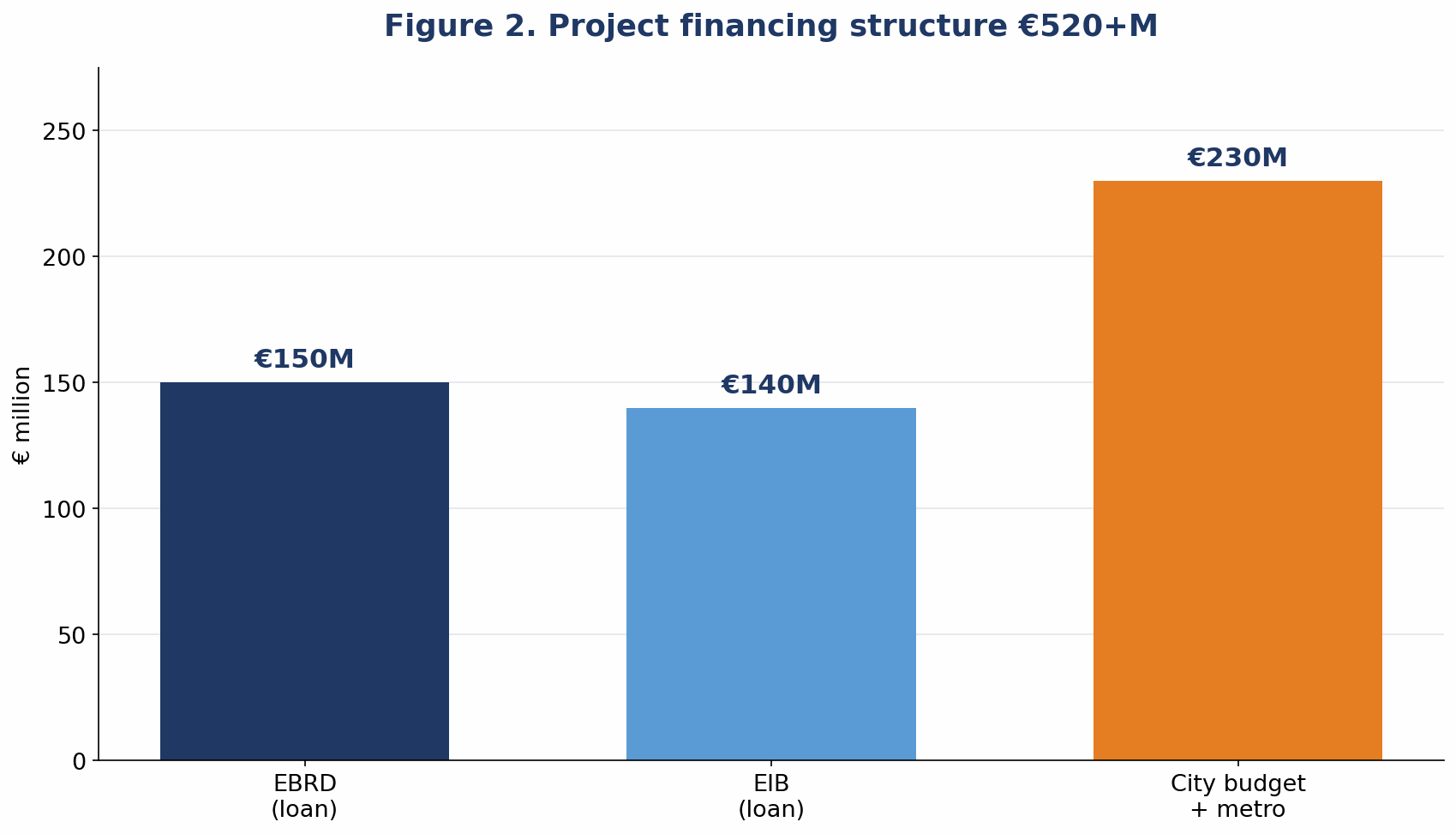
First, the figures, because they set the scale. Decree No. 97 approves a metro rolling-stock renewal project worth over 520 million euros. Of these, 174 cars are to replace the ageing fleet — about 409 million. Another 50 cars are needed for the new Vynohradar line — about 118 million. Loans make up the lion’s share of the financing: 150 million from the European Bank for Reconstruction and Development and 140 million from the European Investment Bank. The city adds the rest from its own budget and the metro’s funds.
This is not the first tranche — and the numbers themselves need untangling. Back in September 2024 the EIB signed a €50 million loan with Kyiv — the first part of an announced €200 million programme to replace Russian-made cars; the bank agreed to provide the rest only after a feasibility study weighing whether it is better to buy new cars or modernise the existing ones. Decree No. 97, in May 2026, names a different figure — 140 million from the EIB paired with 150 million from the EBRD, 290 million in total. How exactly the new deal relates to last year’s €200 million programme — whether it is a continuation or a separate line — has still not been publicly explained, and that vagueness is itself telling. The essential point remains: doubt about the wisdom of a large purchase was sown not by an opponent of the authorities but by the lender itself, which made the money conditional on an honest justification.
And one more detail that is easy to miss. A half-billion-euro decision was made with a single signature — a decree of Kyiv City Council’s executive body. With no public discussion, no public hearings, no visible debate in the council itself. The document became known to the public only when city journalists found it.
2. The factory that twice heard “yes,” then “no”
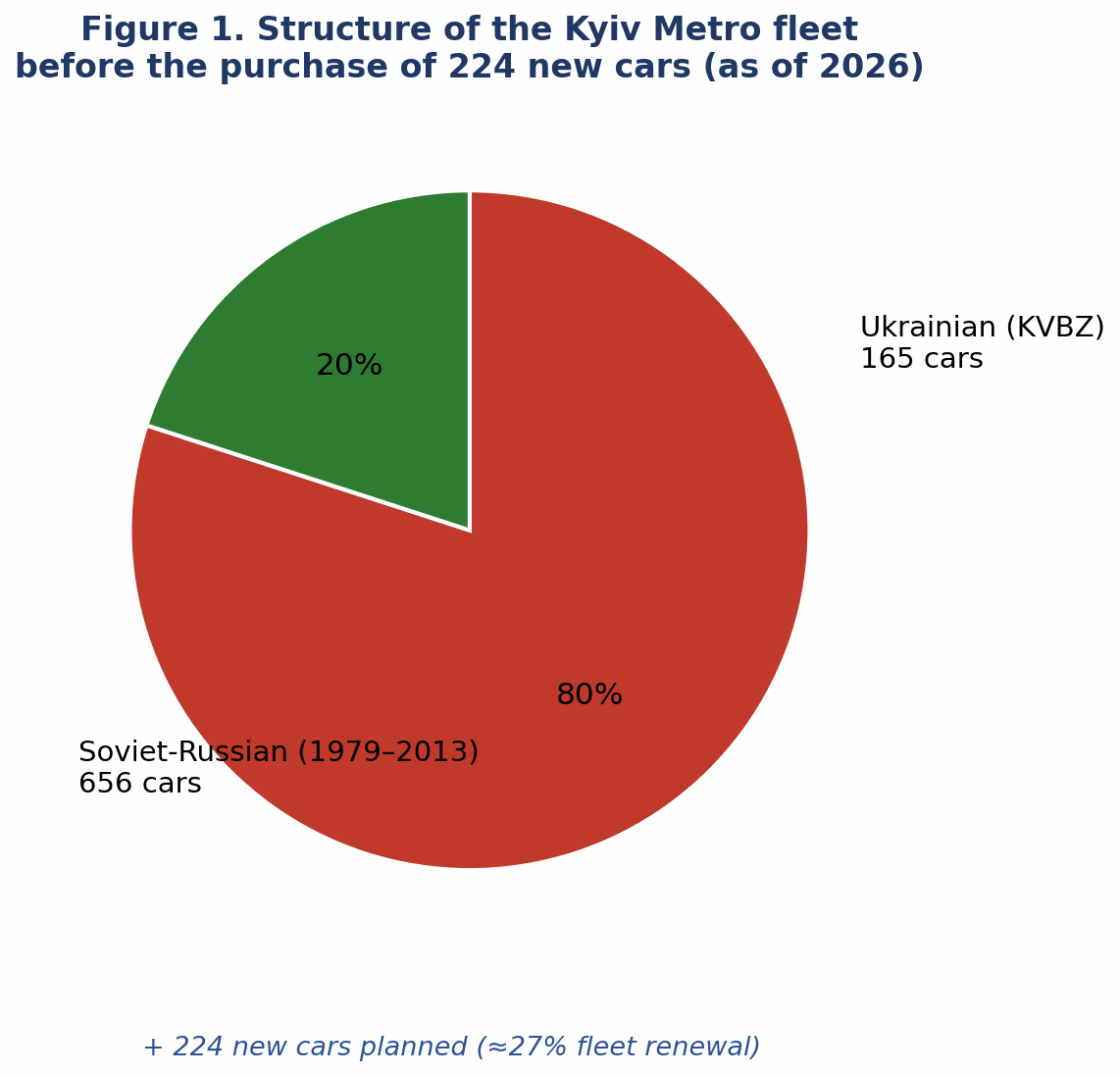
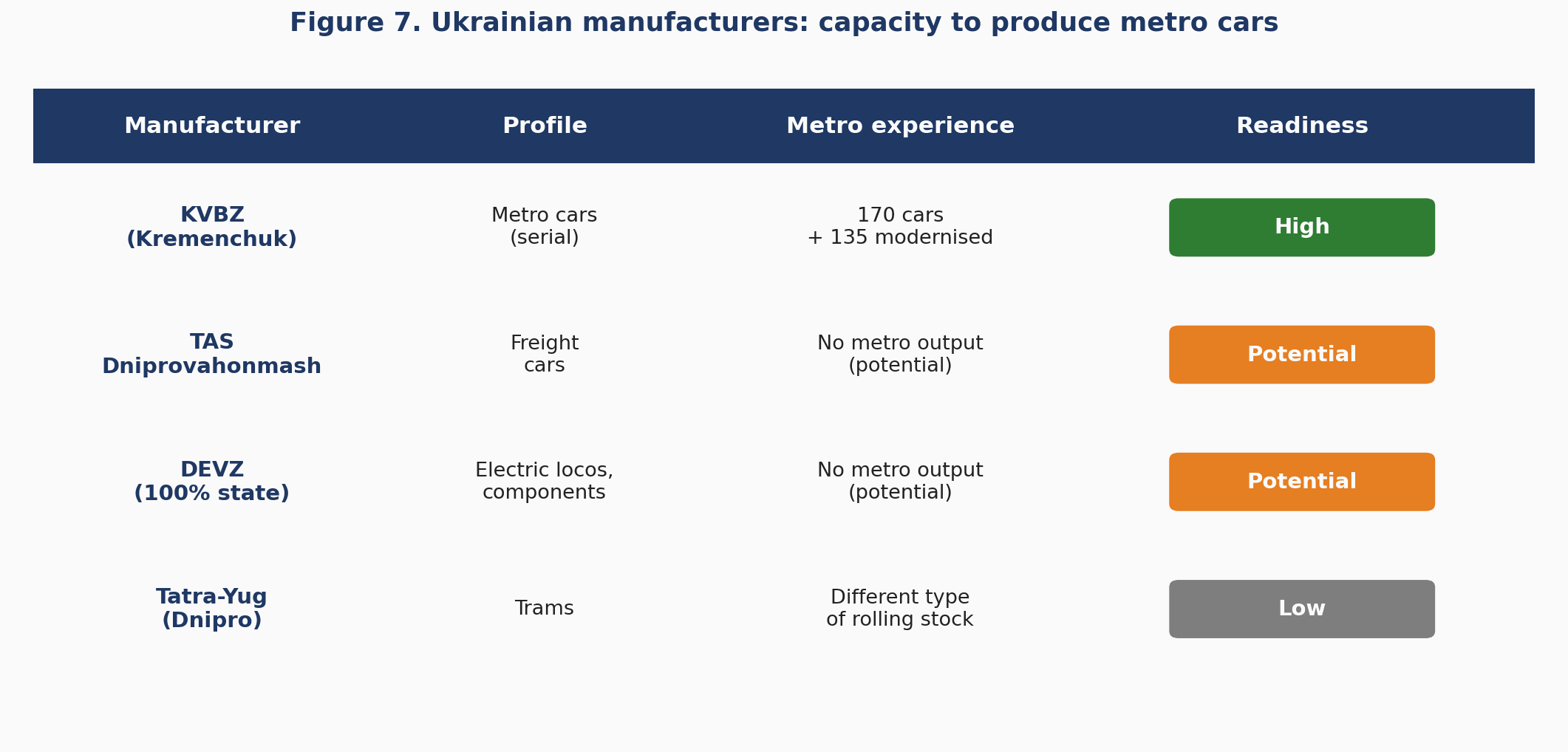
To understand why the Ukrainian producer ended up out of the game, we must go back three years. The Kryukiv Railway Car Building Works is the only enterprise in Ukraine with a proven record of designing and serially producing metro cars. The Ukrainian metro train began to be designed here in 2003, the first cars were built in 2005, and from 2009 the KVBZ train ran on the Syretsko-Pecherska line of the Kyiv underground. Today the Kyiv fleet holds about 165 KVBZ cars — the very “20-per-cent Ukrainian fleet” now cited in reports; Kharkiv also received a batch of trains in its time.
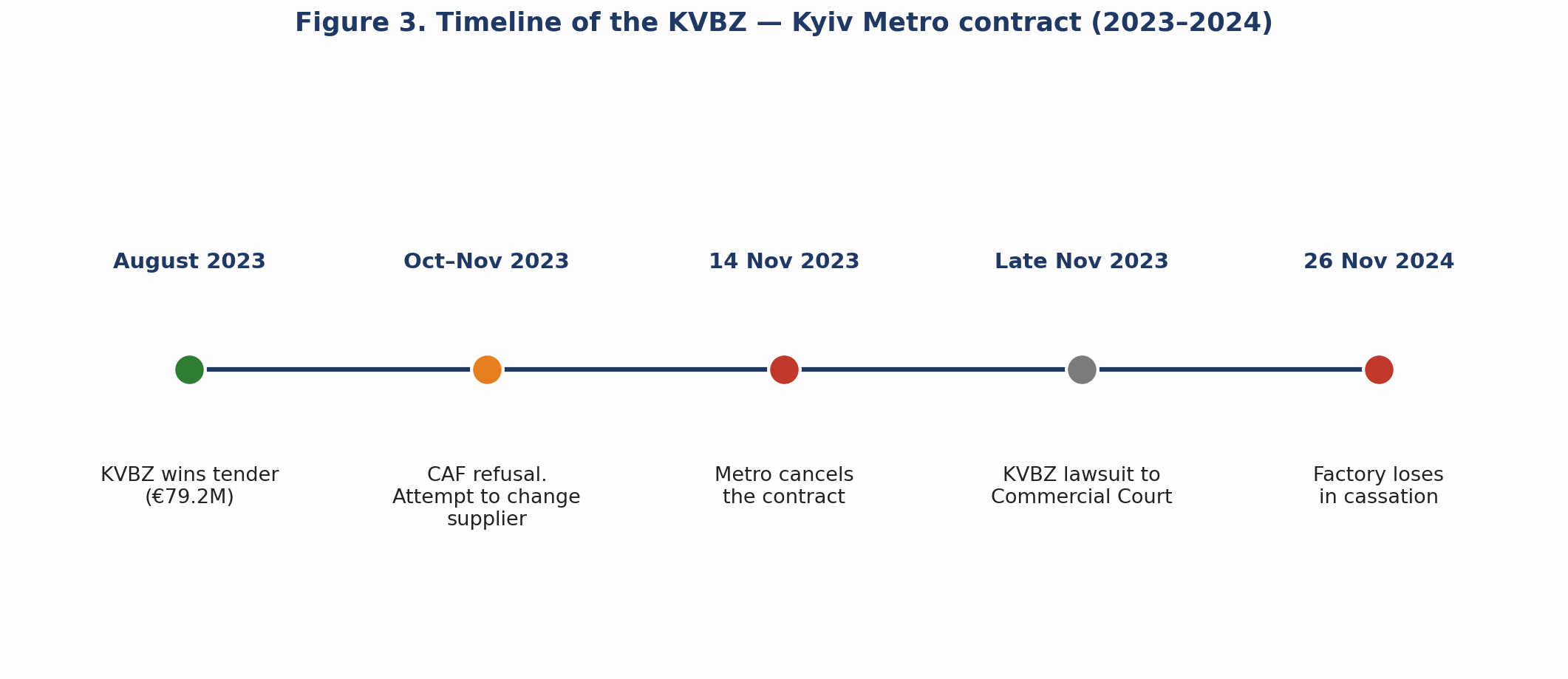
In August 2023 KVBZ won a tender to supply new metro trains — ten five-car sets with open gangways. Its bid of €79.2 million was 37 per cent cheaper than the offer of the Czech firm Škoda. The EBRD financed the contract. It seemed history was turning in favour of Ukrainian industry.
Then came events that each side describes differently. In autumn 2023 KVBZ asked the metro to change the traction-equipment supplier. The Spanish company CAF, whose equipment was written into the bid, had reportedly declined to supply over production-line backlogs. The factory offered alternatives — Poland’s Medcom or Japan’s Melco. The EBRD reacted firmly: changing a key supplier means changing the essential terms of the contract, and under such circumstances the bank may refuse financing. On 14 November 2023 the metro cancelled the contract award. The factory took the case to the Kyiv Commercial Court — and lost; the ruling became final in November 2024.
Here it is important to resist the temptation of an easy answer. The metro’s and the EBRD’s version: the factory failed to meet the tender terms, so it is at fault. The factory’s version: the market made performance impossible — a global component shortage that did not depend on Kremenchuk. Both deserve to be heard. But there is a wider, more painful question that almost no one asks: why, in more than thirty years of independence, has Ukraine never learned to make its own key equipment — and still depends on imported traction systems, power electronics and components? The 37-per-cent undercut shattered on precisely that dependence. The Ukrainian factory won at a price it could not sustain, because the heart of the car — the traction equipment — had to be bought abroad anyway. That is the real problem worth investigating: not one failed contract, but thirty years in which the state never built its own industrial base and chose imports every time.
There is also a separate, long thread in the KVBZ story — the Russian one. Until recently, more than a quarter of the factory’s shares were controlled, through an Austrian company, by the Russian businessman Stanislav Hamzalov. That very fact gave critics grounds for years to call the purchases “from a pro-Russian firm.” But in January 2026 the High Anti-Corruption Court imposed sanctions on Hamzalov, and his stake — 25.07 per cent of the shares — was confiscated to the state. In April 2026 the State Property Fund formally registered this stake. So at the moment Klitschko was signing Decree No. 97, the state was already a co-owner of the Kryukiv works.
One hand of the state owns a quarter of the factory. The other approves a purchase that bypasses that factory.
The factory, meanwhile, was sliding fast. In 2024 KVBZ posted 81 million hryvnias of net profit. In 2025 — already 125 million in losses. The first quarter of 2026 ended almost 48 million in the red, with accumulated losses reaching around 279 million hryvnias. In spring the enterprise declared a forced shutdown: Ukrzaliznytsia, its only large customer, had not paid for delivered cars for almost a year, and the 2026 state budget allocated nothing for new passenger cars at all. To build 60 cars the factory needs 5.7 billion hryvnias, which no one is providing.
And here, straight away, the phrase “there is no money” deserves attention. There is no money for Ukrainian cars — yet from that same Ukrzaliznytsia money keeps vanishing into corruption schemes. We will tally this corruption bill, and all its participants — from Ukrainian Railways to the Kyiv Metro — below, in Section 4.
3. Who will be queueing for the contract
If not KVBZ, then who? The pool of likely suppliers is known: the Czech Škoda, the Swiss Stadler, the Spanish CAF, the French Alstom, the Polish PESA — and potentially the Chinese CRRC, which the EU has, however, already shut out of similar tenders over hidden state subsidies. The European makers are serious, with no political caveats; any of them could fulfil the order. The only question is price: European equipment costs more, which is exactly why the cheaper Kremenchuk used to win.
The main risk, however, is not the choice of a specific supplier but the dependency scheme itself. A metro car is not a passenger automobile. It is 30–50 years of being tied to the manufacturer: spare parts, control-system software, servicing, updates. Long-term dependence on a foreign producer in a country at war means vulnerability of critical infrastructure — and the Kyiv metro is also a network of shelters where tens of thousands of people hide during shelling.
4. The corruption backdrop: actors, episodes, figures
Any large purchase in the railway and metro sector today is read against the backdrop of what surrounds its key players. Below is a consolidated catalogue of documented episodes in which money either vanished systematically or accountability never followed. Everything here is presented under the presumption of innocence: these are open proceedings, cases sent to court and official notices of suspicion — not convictions.
We should begin with the money that “could not be found” for Ukrainian cars — and yet was found for corruption schemes within that same Ukrzaliznytsia. In just the past two years the National Anti-Corruption Bureau and the Specialised Anti-Corruption Prosecutor’s Office have sent to court or completed investigations into a whole series of cases of fraud in Ukrainian Railways procurement: over 140 million hryvnias of losses on cable purchases (the accused include an MP and a former railway official); almost 64 million on wartime food purchases, where the price per kilogram was inflated by roughly 150 per cent; 50 million on pneumatic tools and spare parts, with six current or former railway officials among the suspects; and over 15 million more on paints and linoleum. These are only the disclosed episodes.
The picture becomes especially bitter. While the Ukrainian factory stands without orders, and thousands of its workers without work or wages, in the very structure that ought to be loading that factory money systematically disappears into schemes. The state, it turns out, cannot find funds for its own production — but is quite capable of losing them. This is the very injustice every Kremenchuk worker feels: not “there is no money,” but “there is money, just not for you.”
The second major line of episodes is in the leadership of the Kyiv Metro itself. And its backdrop is grim.
In March 2024 the journalists of Bihus.Info published an investigation into Viktor Brahinsky, who had headed the municipal enterprise “Kyiv Metro” for ten years. According to the journalists, his family’s assets grew by about a million and a half dollars during his tenure. The next day Brahinsky filed his resignation, and the National Anti-Corruption Bureau opened proceedings. In autumn 2024 he was served a notice of suspicion of negligence — over the flooding of the tunnel between the “Demiivska” and “Lybidska” stations, which occurred back in December 2023 and caused the city budget more than 164 million hryvnias in damage. In early 2025 it emerged that Brahinsky had left the country on a forged military medical board certificate. He has been wanted ever since. All these allegations remain at the investigation stage, and the presumption of innocence applies — but the very fact that the metro chief fled the investigation speaks volumes.
And here an uncomfortable thing must be said about the anti-corruption system itself. The Brahinsky case is, in essence, its test. The Bureau opened proceedings, published a notice of suspicion, reported loudly. And the result? The suspect calmly left the country on a forged document and has been wanted for over a year. Punishment — none. Recovery of damages — none. There are loud headlines and a fugitive. And this is a natural question asked ever more often: is the fight against corruption turning into real accountability — or does it remain more of a performance, after which those involved keep both their freedom and their fortunes? This is no reproach to the specific investigators who work conscientiously. It is a question for the architecture itself — and it deserves a separate investigation.
This is not an isolated episode. The metro’s first deputy head, Valeriy Havrylenko, is charged with negligence over which, in 2014, the enterprise overpaid Russia’s “Metrovagonmash” by more than 420 thousand euros — and, again, with EBRD loan money. Construction of the metro to Vynohradar was twice stalled by complaints about discriminatory tender terms; in the end the nearly 14-billion-hryvnia contract went to the company “Avtostrada” after the previous contractor’s deal was terminated.
And it is against this backdrop that a half-billion-euro decision was made with a single signature. This is not an accusation. It is a description of the circumstances in which the deal is taken. And it is precisely these circumstances that demand of the city not ordinary but heightened transparency — which is not yet there.
5. While the ceilings fall
There is another angle from which this whole story looks different. While the city counts cars, its tunnels age faster than the cars.
The first Kyiv metro line opened in 1960 — parts of the tunnels and engineering systems are now over sixty years old. In February 2026 fragments of ceilings collapsed at the “Teremky” and “Chernihivska” stations. The section between “Demiivska” and “Lybidska” still does not work fully after the 2023 flooding. Repair of the stretch between “Taras Shevchenko” and “Pochaina” is estimated at 1.84 billion hryvnias. And monitoring of the tunnels’ condition, experts say, still largely comes down to visual walkthroughs by workers.
The transport analyst Dmytro Bespalov puts it bluntly: the city is entering a period when the main task is not to build new but to hold on to what exists. The metro, he reminds us, is an ultra-expensive mode of transport that not every city and not every country can afford.
“If we simply keep the Kyiv metro in working order, that alone will be a success.”
Hence a question the metro would rather not hear: is it appropriate to borrow half a billion euros specifically for cars when the infrastructure on which those cars will run needs no less investment? The answer is not obvious. Perhaps part of the fleet is cheaper to modernise than to replace — and it is no coincidence that the EIB makes the rest of the loan conditional on an honest feasibility study. Until it is published, the claim “we absolutely need 224 new cars” remains more of a slogan than a proven fact.
6. The bill will be issued to everyone
This section is about how much, and when, the ordinary Kyivan will pay. And the answer is unexpectedly longer than two budget lines. A loan is not a gift: it is a debt the city will repay with interest for 25–30 years. Under the terms disclosed by the city administration, the EBRD loan rate is EURIBOR plus a margin of up to 5.75% per annum. And the ordinary Kyivan will pay for it — at least three times over. The first time — as a passenger, through the metro fare. The second — as a taxpayer, because the hard currency that left the country in a single payment does not return to local or national revenues. And one more, third time — because Kremenchuk without orders means thousands laid off, unemployment-fund payments, retraining and social support, all of which fall on the same state budget that Kyivans pay into. Let us take these in turn.
The first time — as a passenger. The metro fare has not changed since 2020 and still stands at 8 hryvnias. From 15 July 2026 the city plans to raise it to 30 — almost fourfold. Yet the cost of a single ride, according to the metro’s financial plan, reaches 64.5 hryvnias in 2026. Even the new fare is half the cost, so the city will continue to cover the difference from the budget. And servicing the new loan lands on top of that deficit.
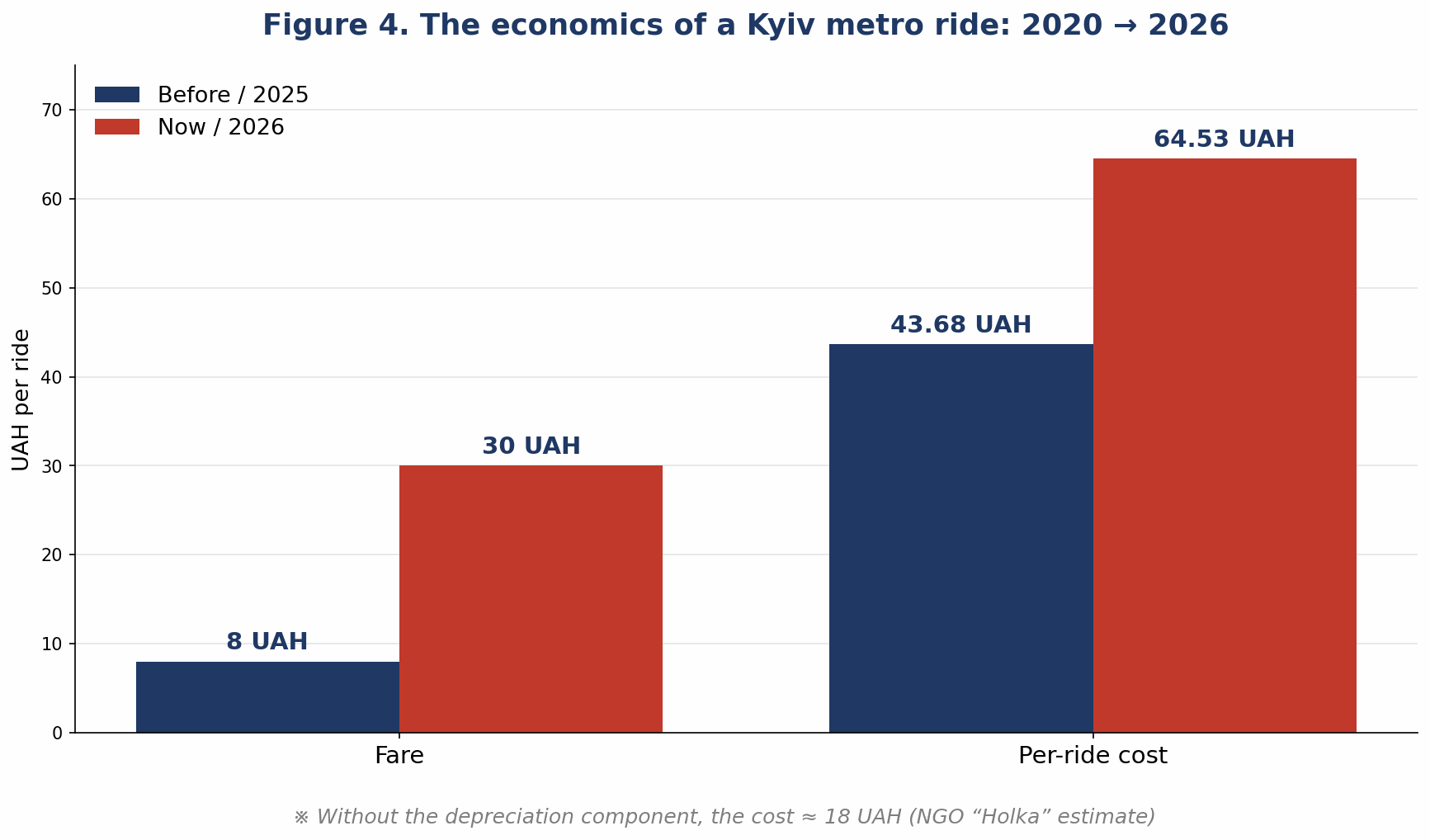
But before agreeing to pay four times more, the passenger has the right to ask a question in return: what, exactly, makes up this cost? The metro itself admits that almost 40 per cent of it is depreciation — funds built into the fare for years, supposedly to renew infrastructure and rolling stock. Analysts at the NGO “Holka” argue the share is in fact larger: by their calculations, depreciation in the cost rose from about 21 per cent in 2018 to almost 58 in 2025, adding around 24 hryvnias to every ride — so without it the 2025 ride would have cost not over 40 but about 18 hryvnias. Whichever estimate you take, 40 or 58 per cent, the main question is the same: it is not about the fare, but about where this depreciation went over the years. For if the billions invested in it had really gone to renewal, the metro would not have entered 2026 with collapsed ceilings at “Teremky” and “Chernihivska,” a flooded tunnel on the “blue” line and a stretch repair costing almost two billion hryvnias. The cost of a ride is an honest mirror of how dearly the city pays for its own mismanagement; and the fare hike risks becoming a way to shift the price of managerial failures and corruption appetites onto a passenger who had nothing to do with them.
The second time — as a taxpayer. And here begins the least visible but most important part of the bill. When a half-billion order goes abroad, hard currency leaves Ukraine in a single payment — and does not return. A domestic order, by contrast, would work differently: workers’ wages are personal income tax, a large share of which goes to local budgets; they are the unified social contribution; they are profit tax on the producer and dozens of subcontractors; they are VAT at every link of the supply chain. According to economists’ estimates, a domestic industrial order returns a tangible share of the contract value to the consolidated budget. With imports, that return is close to zero.
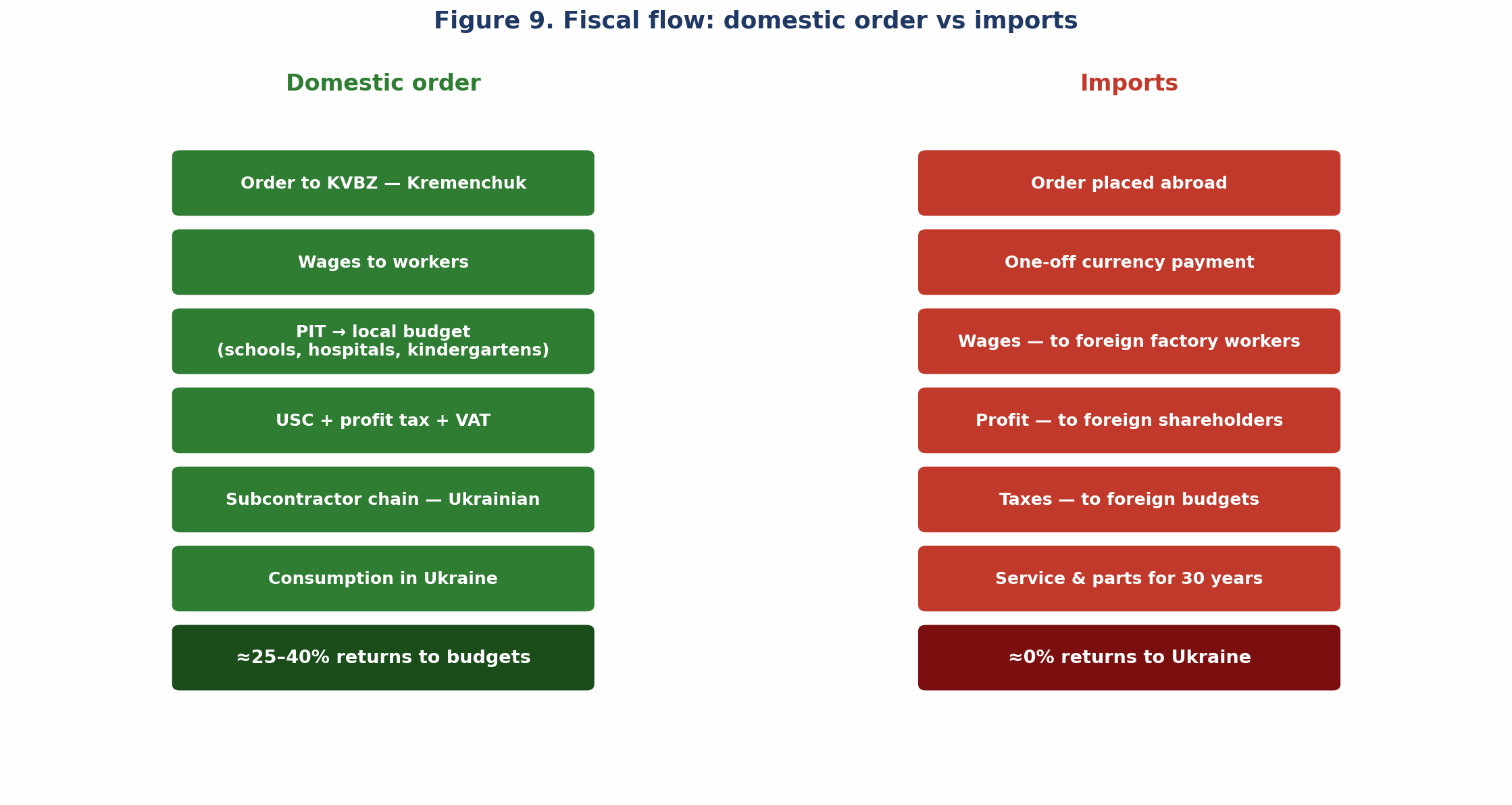
Kremenchuk will feel this most acutely. Idleness or layoffs at the Kryukiv works mean direct losses of personal income tax for the city budget, rising unemployment, an outflow of skilled staff and a blow to the small business of an entire district that lives off workers’ wages. And then a chain reaction sets in, well known to every industrial city in Ukraine: when a budget receives less personal income tax, the first to fall under “optimisation” are precisely hospitals, schools and kindergartens. They are merged, consolidated, closed — because “there is nothing to maintain them with.” The factory’s shutdown therefore hits not only its workers but also the child who will be taken to another, more distant kindergarten, and the patient who will be driven to another, more distant hospital. The loss of competence after a break in the generations of engineers is almost impossible to restore. And so, if KVBZ stops for good, future purchases for Kyiv, Kharkiv and Dnipro will be imported forever. Forever in foreign currency. Forever dependent.
And here it is — that very third time the Kyivan pays. Every laid-off Kremenchuk worker passes onto the state’s support: payments from the State Social Insurance Fund for unemployment, retraining programmes, social assistance to families. These expenditures are not set aside separately in the budget — they appear either through a heavier tax burden or through cuts to other areas. So the Kyivan taxpayer will pay yet again for unemployment that Kyiv itself caused by bypassing the Ukrainian factory. A purchase abroad generates here not two waves of the bill but three — and this is the case where “saving” on a tender returns, with interest, as the cost of one’s own de-industrialisation.
And this is only today’s bill. The greatest risk lies ahead, and it is the currency risk. The loan is taken in euros, and the city will repay it for 25–30 years. The war will end sooner or later — and it is quite likely that, along with it, the flow of external financing that today keeps the hryvnia relatively stable will begin to wind down. Less currency from outside means a weaker hryvnia. And a weaker hryvnia means that the same sum in euros will cost Kyiv ever more hryvnias each year: a payment calculated today may, in ten years, multiply — not because the city borrowed more, but because the exchange rate changed. Then comes the trap. Servicing the foreign-currency debt will eat up an ever-larger share of the budget, and the city will be forced both to raise the metro fare — again and again, with 30 hryvnias turning out to be not a ceiling but merely a step — and to cut social infrastructure: optimise schools, close kindergartens, merge hospitals. The metro turns from transport for all into transport for those who can afford it; there will not be enough money for tunnel and bridge repairs, and worn infrastructure does not know how to wait. This is a scenario in which not only the metro grows poorer — the whole city grows poorer, right up to the limit beyond which it can no longer sustain itself.
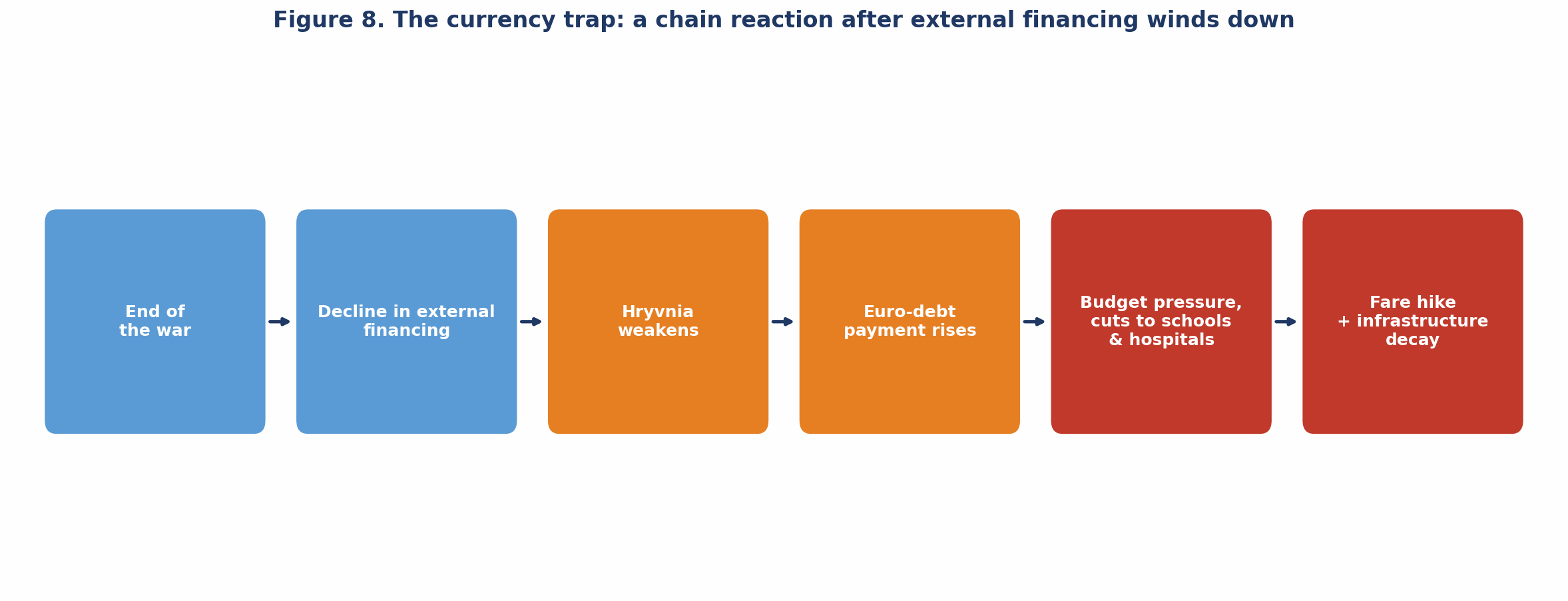
30 hryvnias per ride is not the ceiling. It is only a step.
Do they understand this in the city hall and the Cabinet of Ministers? The honest answer is — they do. The currency risk of long-term debt is no secret knowledge: any financier sees it. And that is precisely why the design of this decision raises the most questions. Its benefit is immediate and visible — new cars, a ribbon cut, a report saying “we have renewed the metro.” But the price is deferred: it will fall on budgets, fares and on officials who, in ten or twenty years, will no longer hold these posts. This is the classic shifting of the burden onto those who come later. There is no evidence of collusion or corruption specifically in arranging this loan — and an honest text must not invent any. But something else is proven: a half-billion-euro decision was made with a single signature, without public discussion, by a city whose former metro chief is on the wanted list. The community that will repay this debt for thirty years would at the very least have the right to know what currency burden has been placed on it — and why no one consulted it about that.
Seven questions worth putting to the city hall
- Where is the published feasibility study on which the EIB makes the rest of the loan conditional?
- Why was a decision worth more than half a billion euros made by Decree No. 97 without public hearings?
- What is the projected loan payment in hryvnias under different exchange-rate scenarios over a 25–30-year horizon?
- Why was the purchase of 224 cars not split into two lots — 50 urgently for Vynohradar and 174 subject to the feasibility study?
- Was the in-house model (the Teckal doctrine) and direct cooperation with the Ukrainian producer considered — and if not, why not?
- How does the fare hike to 30 UAH relate to servicing the new debt and to the 64.53 UAH cost?
- What transparency and anti-corruption safeguards are built into this purchase given the metro’s history?
7. Three rules that cancel each other out
At this point one wants to ask: did no one provide protection for the Ukrainian producer? They did. The protection, by design, simply does not work precisely when it is most needed.
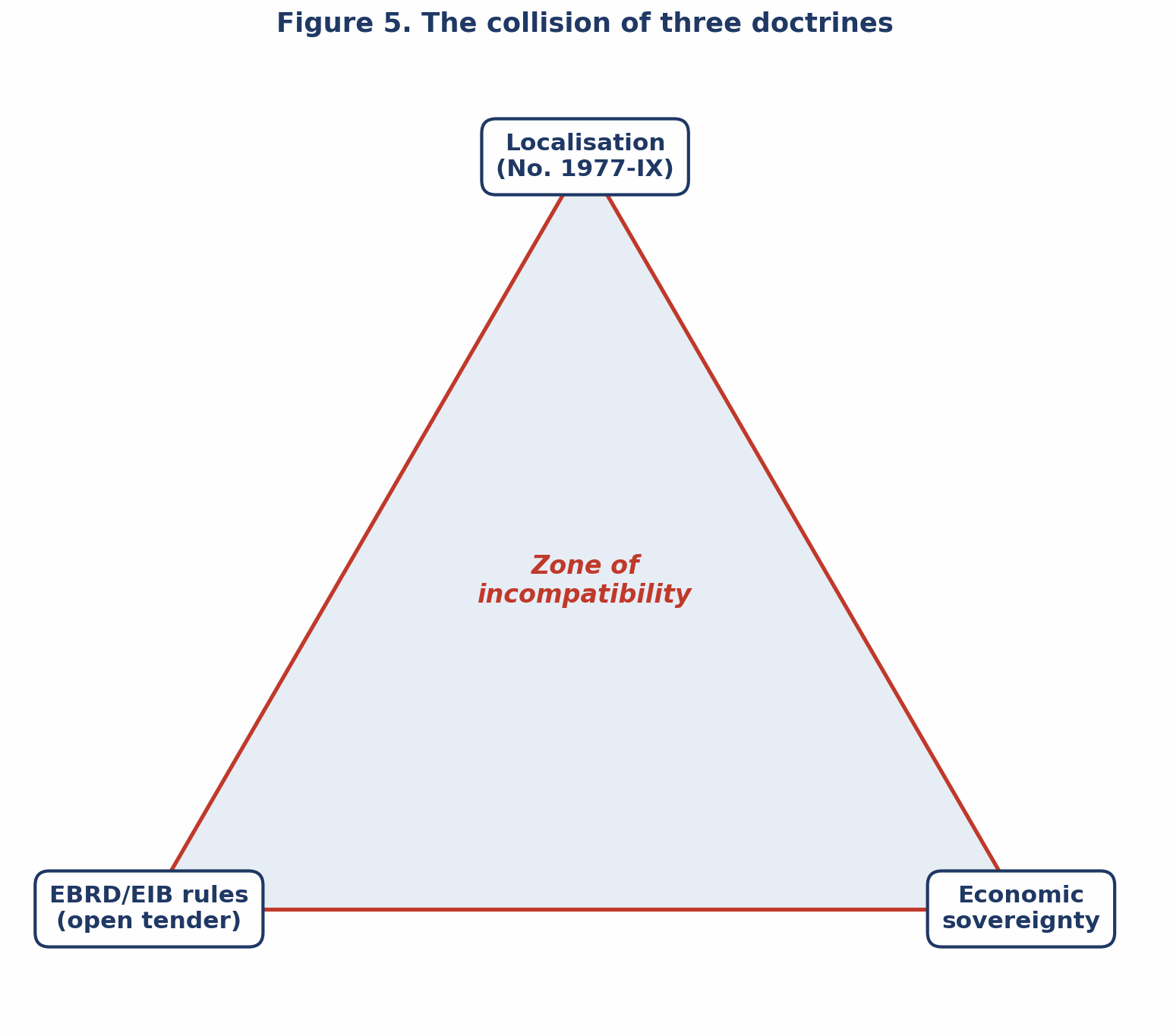
The first rule is the law on localisation in public procurement (No. 1977-IX). It requires that for machine-building products, including metro cars, the “degree of localisation” — the share of value created in Ukraine — be taken into account. It would seem the perfect instrument for our case. But the law contains direct exemptions: localisation requirements apply neither to goods from countries party to the WTO Agreement on Government Procurement (which is the entire EU), nor to procurement financed by international financial institutions. So a purchase made with EBRD and EIB loans is twice exempted from localisation. Under current law the Ukrainian producer has no advantage whatsoever — and the legislator provided for exactly that.
The second rule is the banks’ own procurement policy. EBRD-financed projects are run as open international tenders: maximum competition, equal access for foreign companies, no national protectionism. The banks’ logic is understandable — they protect their money from corruption and inefficiency, not a particular economy. Procuring “for one’s own” contradicts the very idea of such financing.
But this “understandable logic” deserves to be examined from another side too — one rarely discussed in public. First, an open international tender is not the only lawful way to spend the money. EU law itself recognises the so-called in-house principle, the Teckal doctrine, enshrined in the 2014 EU public procurement directive. If a public authority controls a contractor as its own unit, and that contractor works mainly for this authority, assigning it work is not considered a “procurement contract” at all — and, crucially, is not a breach of competition. This is not a loophole but a norm of European law: a territorial community acting through its own enterprise is neither obliged nor required to run a tender with itself. The European Investment Bank aligns its procurement rules with EU law — and so the in-house principle itself is nothing forbidden or anti-competitive for European financing. The obstacle here is not legal but political: the in-house model is fully compatible with lending from European banks — it simply has to be deliberately built into the project rather than rejected out of hand under the slogan “no protectionism.” Second, an international bank loan never comes “bare.” With it come mandatory external consultants, technical advisers and feasibility studies — paid for out of the same loan the city later repays. That very feasibility study, on which the rest of the money depends, is financed from the loan itself. The result is a closed loop in which the bank lends — and at the same time pays for its own expertise that justifies the loan. This is not collusion but the design of the international-financing model, which those enchanted by “cheap European money” prefer not to mention.
The third rule is not even a norm but a doctrine: economic sovereignty. Preserving strategic enterprises and industrial competences is an element of defence capability, especially in wartime. The cheapest offer today does not equal the most advantageous solution over a thirty-year horizon.
Ukraine wants both cheap European loans and protection of its own industry. The rules of these loans deliberately remove the protection.
This is the crux. The conflict of these three rules is not anyone’s mistake or the ill intent of a particular official. It is built into the very design. And as long as there is no mechanism reconciling the three goals, every large purchase made with international-bank money will automatically play against the Ukrainian producer. The story of the 224 cars is no exception. It is a system.
8. What can actually be done
The easiest thing is to end the text with a reproach. But a reproach changes nothing, so let us name the solutions that actually exist.
First of all — unblock KVBZ. A factory that stands idle can claim nothing. The question of Ukrzaliznytsia’s debt for already-delivered cars is resolved at government level, and it must be resolved immediately, separately from the metro story.
Second — abandon the illusion that the problem will be solved by simply assembling someone else’s units on a Ukrainian site. Ukraine already has this lesson. The DS3 electric locomotive was built by the Dnipro Electric Locomotive Works jointly with Siemens: the Germans supplied the traction-drive power electronics, Ukrainians made the mechanical part, the traction motors came from the Smila plant. From 2002 to 2008 only 18 machines were built — and then, the moment the economic crisis struck, the project was wound down and production never resumed. “Screwdriver” partnership, where foreign units are bolted on under a local logo, creates neither an engineering school of one’s own nor independence: political will fades or a crisis comes — and assembly stops, leaving the country with nothing. The point is different: restoring full production — with its own design, design bureaus, training of personnel and a chain of Ukrainian suppliers. This is more expensive and slower than importing. But it is the only option in which the country preserves industry rather than imitating it. The remaining concrete steps — from splitting the purchase to coordinating the actions of the state-owner and the state-customer — are summarised in the “Five solutions” list below.
9. From the author: enough playing at markets
Everything above is facts, documents and questions. What follows is a candid authorial position, and I mark it deliberately. For there are things a journalist has the right to say plainly.
The Kryukiv Railway Car Building Works stands in Kremenchuk, in the Poltava region — in the right-bank historical locality of Kryukiv, which gave the enterprise its name. The factory was founded back in the century before last, in 1869. It is older than two world wars, than Soviet rule and than independent Ukraine. Kryukiv grew up around it — a classic company town, where the factory’s work and the district’s life are, in essence, one and the same.
Today the ownership of this factory is complex. The majority of shares belongs to a private owner. A quarter — since April 2026 — belongs to the state: this stake was confiscated from a Russian businessman who had held it for years through an Austrian company. So part of a strategic Ukrainian factory was controlled from abroad for years, through an opaque structure — and only a court put this right. My position: this state quarter should become not a formal line in the State Property Fund’s register but the start of a different logic. A strategic factory in a country at war must work for the people of the city where it stands, and for the state that defends it — rather than being an asset whose value dissolves into someone’s accounts. The Kremenchuk community has the right to a voice in the fate of the enterprise that feeds its district — and the state must ensure that voice.
A factory that works is not an abstraction. It is the tax that pays for Kremenchuk’s school and hospital.
And there is no pathos here — just the arithmetic already laid out above: workers’ wages, through personal income tax, fill the local budget, and that means schools, hospitals and kindergartens in Kremenchuk. A factory that stands idle pays nothing. The KVBZ shutdown is not only the problem of a few thousand workers; it is less money in the classrooms and hospital wards of an entire city. That is what the phrase “the factory must work for the people” really means.
The same applies to Kyiv — only from the other side. The capital’s community also spends money: on fares, on taxes, on servicing future debt. And this money can work in different ways. It can create jobs — here, at Ukrainian enterprises, in the public and industrial sectors. Or it can simply go abroad, leaving the city only the bill. A healthy city builds employment, not merely cushions the consequences of its absence. To spend half a billion so that the work is born in Ukraine is not charity. It is the cheapest way not to pay later for unemployment.
And now the most unpleasant part. The city is raising the fare — from eight hryvnias to thirty. Part of this money will go to servicing the loan. And if the cars are bought abroad, a simple and bitter equation results: the Kyivan will pay more so that the money leaves the country. Wages will go to the workers of foreign factories, profit to foreign shareholders, taxes to foreign budgets. And along with the money we also buy dependence — thirty years ahead, on the spare parts and servicing of a supplier that Kremenchuk’s engineers did not choose. The Ukrainian passenger pays — foreign industry grows. There is no ill intent here — it is simply what happens when the state does not calculate the consequences.
And one more “feeding,” without which the picture would be incomplete — the feeding of corruption. For many years we were told that the answer to theft would be a separate anti-corruption vertical — NABU, SAPO, the HACC. In my conviction, this construction has failed to live up to its promises, and the reasons are structural. Back in 2020 the Constitutional Court found unconstitutional the decree appointing the head of NABU (Decision No. 9-r/2020 of 28 August 2020) — the foundation was built in haste, bypassing the Basic Law. Add the decisive role of foreign experts in selecting anti-corruption judges — in effect a delegation of a sovereign function of the state to the outside — and the practice in which high-profile cases drag on for years without a verdict, while those involved, like the former metro chief, calmly flee abroad. I phrase this sharply on purpose, because this is an authorial position, not a report: the anti-corruption system in its current form imitates the fight rather than punishing — and thereby objectively creates a more convenient environment for corruption than it destroys. Defenders of the current model sharply dispute this thesis, and the reader has every right to argue. But without an honest conversation about it, any plan to save the factory or the metro will remain a conversation about money that dissolves again. A detailed analysis of this very construction — from the unconstitutional foundation of the anti-corruption bodies to the legalisation of assets through the ECtHR — I set out in a separate study, “The Anti-Corruption Trap: How NABU, SAPO and the HACC Legalise Grand Corruption.”
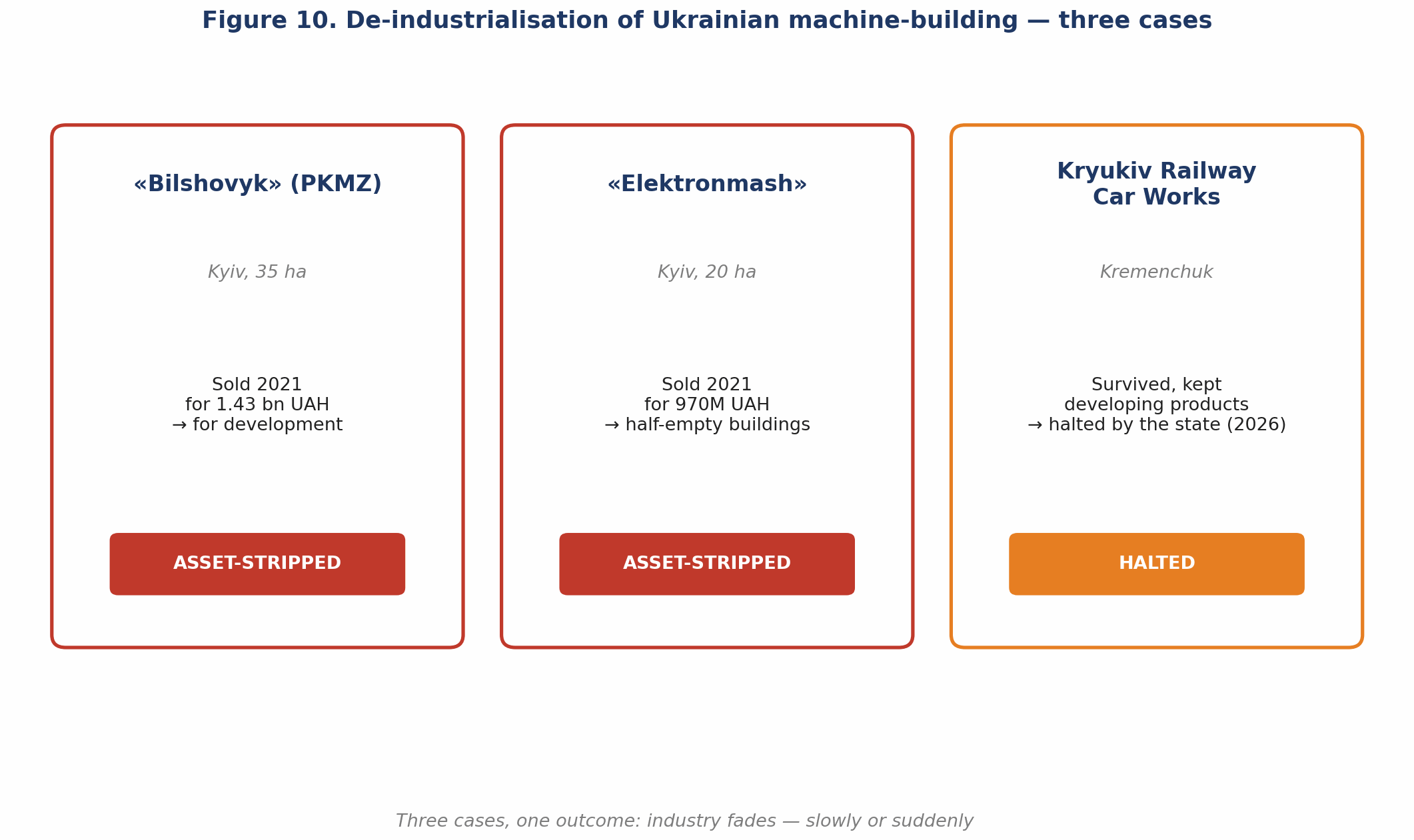
And one more thing must be said honestly, for without it the conversation about saving the factory would hang in the air. Ukrainian industry was indeed largely destroyed — but destroyed mostly not by malicious modernisation but by quiet neglect. The Kyiv giants “Bilshovyk” and “Elektronmash” are classic examples: enterprises died for years until only half-empty buildings remained, and then the state sold not the production but the land beneath it. “Bilshovyk” went under the hammer in 2021 for 1.4 billion hryvnias — together with 35 hectares in central Kyiv that await development. Buyers were interested in the hectares, not the machine tools. This is the real mechanism of de-industrialisation: not loud plunder, but silent consent to let a factory die so that its site can later be sold profitably. Against this backdrop, the Kryukiv works is a rare exception. It was not “carved up,” it did not become a shopping mall, it spent all these years designing and producing equipment. And that makes the finale all the sharper: an enterprise that survived against all odds is today being stopped no longer by a private marauder but by the state itself — through a lack of orders, unpaid debts and indifference. To kill the survivor is no longer negligence. It is a choice.
So what is the way out? In my conviction — not a cosmetic one. The factory will not be saved by a change of director or yet another supervisory board. What is needed is a change in the very architecture of ownership and management — what I call in my works the Single Legal Entity of Public Law — Economic Entity (SLEPL-EE) model. In this logic the territorial community ceases to be an outside “shareholder” and becomes the sole owner. The Kryukiv works should return to the Kremenchuk territorial community — not as yet another municipal “appanage prince” with its own seal and its own tenders, but as a structural unit of the territorial community, a part of its industry department. Without intermediaries, without shell firms, without the margin that settles into someone’s pockets under the guise of “procurement.”
Here it is crucially important how exactly the factory ends up in the hands of the territorial community. Not through labels and not through the slogan “cancel privatisation,” but through a transparent political decision within the law. The state already has a starting position — 25 per cent of the shares, lawfully confiscated from the Russian beneficiary. This stake can be increased: by voluntary buy-out of other shareholders at market price, by exchanging shares for guaranteed orders and investment, and, if lawful grounds are found, by nationalisation as provided for by law, with due compensation to owners. None of these paths requires declaring anyone’s property “criminal” without a court verdict. What it requires is something else — the political will to recognise rail-car building as a strategic industry that the state and the territorial community take under control deliberately, openly and by the rules, rather than as a fait accompli.
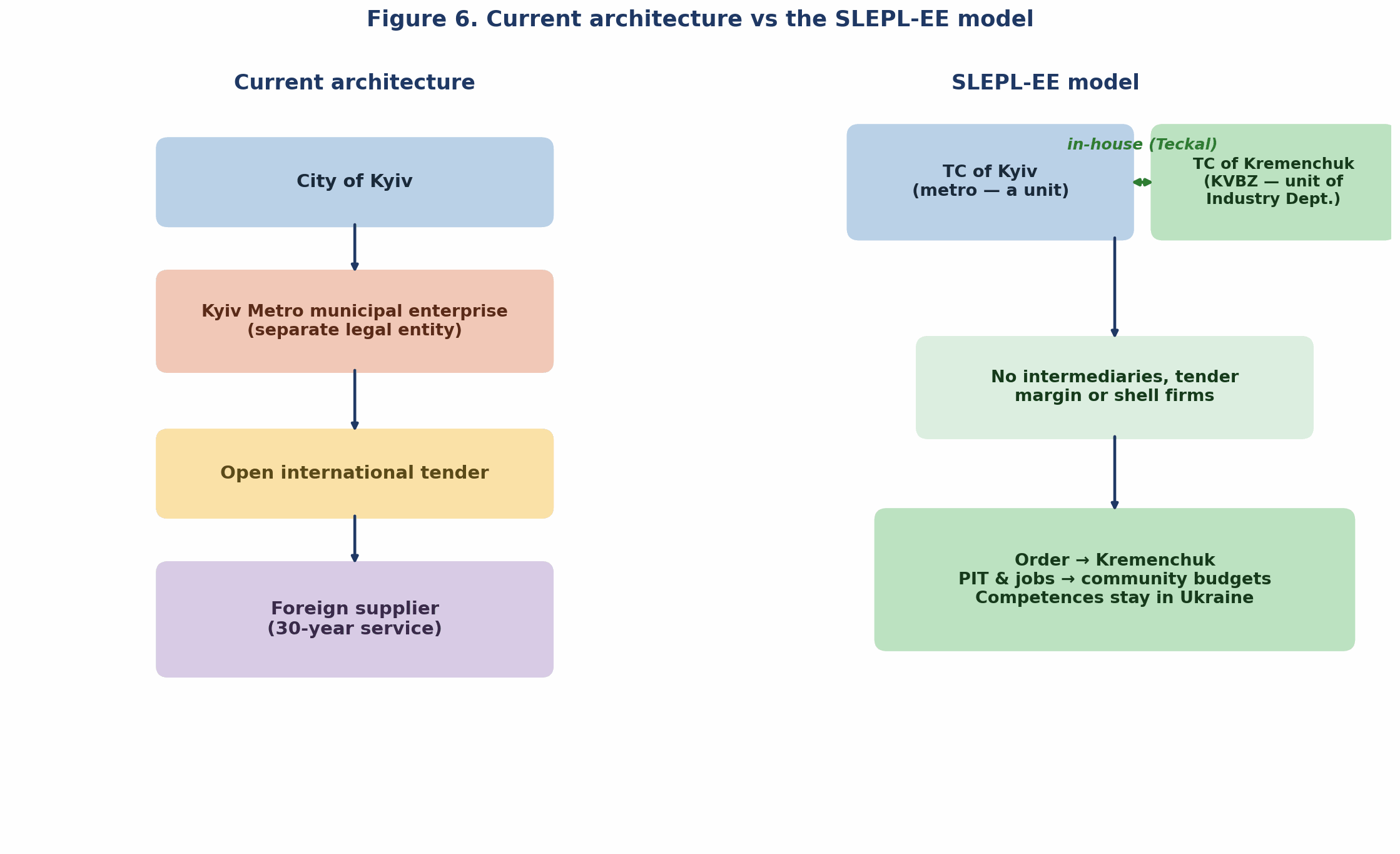
Two territorial communities should help each other directly — not feed a chain of intermediaries between them.
And now the most important point. Two territorial communities — Kremenchuk, which knows how to make cars, and the capital Kyiv, which needs them — should help each other directly. One community produces, the other buys; money moves between two public owners on the in-house principle rather than vanishing into a chain of tender intermediaries. This is the alternative to “feeding corruption”: when a Kremenchuk worker’s tax sustains a Kyiv school, and a Kyiv metro order gives work to a Kremenchuk hospital through the city budget, both communities win, and not a single kopeck has any reason to disappear along the way. This is how the solidarity of communities works. This is how the market of intermediaries does not.
There is also a separate duty of the capital. Kyiv is not just the largest city; it is the capital, and so it bears a direct responsibility to keep the country together. Supporting the regions is not the Kyiv community’s charity but its direct interest. For without the regions there is no Ukraine: it lives where Ukrainians live, work and raise children. If there is no work in Kremenchuk, Ukrainians will leave, and Ukraine at that point on the map will simply fade. Fewer Ukrainians in the regions means less of the country itself. And a capital cut off from the country it is meant to embody will, at this rate, turn into an expensive but emptying city in which the Ukrainian people once lived. So helping Kremenchuk — and indeed every manufacturing town — is for Kyiv not a choice but an instinct of self-preservation.
Here it is worth saying the uncomfortable thing too — about what Kyiv risks becoming if it ignores this duty. Ever more often comes the reproach: the capital has begun to lose its own agency. A city that ought to generate ambitious projects and ideas of its own too often lives not on them but on “absorbing” the state budget — and thereby comes dangerously close to the model of the eastern neighbour’s capital: a city that consumes the country rather than serving it. The symptoms of the same logic are visible not only in the metro. The crisis of the largest city developer: despite a recapitalisation from the city budget of 2.56 billion hryvnias (completed in spring 2026), tens of thousands of investors have for years been unable to receive their flats, while critics see such budget “injections” as an election technology rather than a transparent completion plan; tender scandals; worn-out transport — all of this links of one chain. Kyiv risks turning into a platform for PR and budget absorption — and it is precisely then, stripped of its own meaning, that it begins quietly to fade, however many purely capital functions remain in it.
But the capital can — and must — be otherwise. The status of a capital is not a privilege to consume the country’s budget but a duty to lead the country. A true capital is the heart of local self-government and statehood, a centre of education, science and high-tech production — not a city of kickbacks. Kyiv’s real role is to be the capital of Ukrainian science, culture and production, and a centre that supports and protects every territorial community rather than competing with them all for state funds. A city that, instead of skimming, puts its orders into Ukrainian production — into Kremenchuk’s cars — does not lose its status but fills it with meaning for the first time: a capital that gives work to the country rather than taking from it. The same logic must descend to the very bottom — to the building and the neighbourhood, to the bodies of self-organisation of the population, where a resident’s tax becomes the community’s common fund rather than a source of enrichment for intermediaries. The question is not how large or prestigious Kyiv is, but what it is in essence: a true capital that protects communities — or a corrupt city that lives off skimming them.
And this is more than economics. When communities help one another — when a Kremenchuk factory works for the Kyiv metro, and a Kyiv order gives work and tax to Kremenchuk — the country becomes not a set of scattered patches but a single living organism. It is precisely such ties — industrial, financial, human — that weave a territory into a state more firmly than any lines on a map. The alternative is well known: a model in which every oligarch, every “overseer,” every isolated business lives by the principle “every man for himself, and God for all” and fights everyone else to the death. Such a model does not build a state — it divides it into appanage princedoms. And a country divided into appanages does not withstand war. The solidarity of communities is not a sentimental slogan. It is a question of whether Ukraine holds together as a whole.
And the last thing, the one that troubles most. The country still has engineering schools — design bureaus, technologists, bearers of experience accumulated over generations. There are not many left. Every stopped factory is not only lost jobs; it is an extinguished hearth of engineering culture. These schools must work for Ukraine and create good for its people — here, at home, not abroad and not for someone else’s economy. To preserve them is cheaper than to wind them down. But to restore them, once they go out for good, will no longer be possible for any money.
Economic sovereignty, the SLEPL-EE model and the rescue of the engineering schools all come down, in the end, to one simple thing. The Kryukiv works must be not a chance victim of tender rules but a deliberately preserved strategic asset that the state and communities guard just as they guard the army or the energy system. For a metro car is also a matter of security. For thirty years Ukraine played at markets where the market by itself does not work — in the sphere of the strategic industry of a state at war. The cheapest offer today turns into the loss of the factory, of engineering competences and of independence tomorrow. It is time to admit a simple thing: this is no longer about efficiency. It is about survival.
Five solutions: what the city should do
- Unblock KVBZ. Settle, at government level, Ukrzaliznytsia’s debt for already-delivered cars — separately and immediately.
- Split the purchase. 50 cars for Vynohradar — urgently; 174 to replace the fleet — subject to a published feasibility study.
- Build a lawful mechanism for Ukrainian industry’s participation: framework talks with the EBRD/EIB on a local component, a service hub and technology transfer.
- Apply the in-house model (Teckal): direct cooperation between the Kyiv and Kremenchuk communities without tender intermediaries, compatible with European financing.
- Coordinate the actions of the state-owner and the state-customer: use the 25.07% KVBZ stake as a starting position for public control within the law (buy-out, exchange of shares for orders, nationalisation with compensation).
This is an expert vision of governance reform, not an election promise.
Conclusions
- A half-billion-euro decision on 224 new Kyiv metro cars was made with a single signature of the city administration, without public discussion — at a moment when the only Ukrainian producer of these cars, the Kryukiv Railway Car Building Works, is shut down for lack of orders and unpaid Ukrzaliznytsia debts, while the 2026 state budget allocated nothing for passenger cars at all. This is not a coincidence but a hallmark of a managerial design in which the benefit of the current authorities’ decisions is immediate and visible, while the price is deferred to future budgets and generations.
- The current legal framework systemically bars the Ukrainian producer from such purchases: Localisation Law No. 1977-IX exempts procurement financed by international financial institutions from localisation requirements, and EBRD and EIB rules mandate an open international tender with no national preferences. Under current law the Ukrainian producer has no legislative advantage — and the legislator provided for exactly that.
- At the same time the in-house principle (the Teckal doctrine, 2014 EU directive) is expressly recognised in EU law as not constituting a procurement contract and not breaching competition. The route of direct cooperation between public bodies — territorial communities — lawfully exists. The obstacle here is not legal but political.
- The purchase creates a long-term currency risk for the Kyiv territorial community: a euro loan for 25–30 years will, if the hryvnia weakens in the post-crisis period, cost many times more in hryvnia terms than today. This threatens the city’s ability to maintain social infrastructure and leads to repeated fare hikes and further degradation of tunnels and bridges.
- The metro has a documented corruption record (the Brahinsky case, proceedings against the deputy, scandals around the Vynohradar tenders), and the anti-corruption vertical, on the example of these cases, demonstrates the imitation of accountability rather than results. Taking on a new large foreign-currency obligation in such circumstances — without public discussion and a transparent feasibility study — is a subject of criticism in its own right.
- The systemic way out is the Single Legal Entity of Public Law — Economic Entity (SLEPL-EE) model: the Kryukiv works as a structural unit of the Kremenchuk territorial community within its industry department; direct in-house cooperation between the Kremenchuk and Kyiv communities with no intermediary chains; the state stake (25.07%), lawfully confiscated from the Russian beneficiary, as a starting position for building public control within the law (buy-out, exchange of shares for orders and investment, nationalisation with compensation).
- Without reconciling the three doctrines — localisation, the international banks’ rules and economic sovereignty — and without implementing the SLEPL-EE model, every large purchase made with loan funds will reproduce the same outcome: taxpayers’ money and the debt burden will stay in Ukraine, while orders, jobs, engineering competences and the tax base will flow outward. This is no longer a question of efficiency but of the survival of Ukrainian industry and, more broadly, of the country’s ability to remain whole.
Epilogue
Let us return to Kremenchuk. To the factory whose workshops are silent. Cars once left here that carried Kyivans beneath Khreshchatyk and Kharkivites beneath Constitution Square. The factory is older than independence — and may well not outlive it, if nothing changes.
And in Kyiv a new car will arrive after all. Perhaps Czech, perhaps Swiss, perhaps the cheapest. It will be bright, quiet, with an open gangway. A passenger will step into it without thinking about the loan, the interest, or the factory four hundred kilometres away.
He will not think about the other thing either. That the engineers who could have designed such a car here, at home, will no longer design it — because many of them are simply no longer in Ukraine. Designers, technologists and welders, with their families, are settling in Poland, the Czech Republic and Germany, building someone else’s railways and someone else’s prosperity day after day. A factory that stops loses not only orders — it loses people, and with the people the school, the experience, the very ability to make complex things. And if nothing changes, Ukraine will later have to buy abroad the very engineers it is pushing out today. A country that grows used to exporting its own engineers instead of its own cars is slowly — quietly, without a single loud decision — deciding what it will be tomorrow, and whether it will be at all.
And perhaps one day someone will ask a simple question — literal and at the same time not quite. What will be the end of this tunnel?
Frequently asked questions (FAQ)
How much does Kyiv’s new metro-car purchase cost?
The project exceeds €520M: a €150M EBRD loan, a €140M EIB loan (€290M together), with the rest from the city budget and the metro operator’s funds. It covers 224 cars.
When and by how much does the Kyiv metro fare rise?
From 15 July 2026 the fare rises from 8 to 30 UAH — almost fourfold. Even the new fare is half the per-ride cost (64.53 UAH per the financial plan), and servicing the new foreign-currency loan lands on top of the budget deficit.
Who pays for the new cars?
Ultimately the Kyiv resident: as a passenger (via the fare), as a taxpayer (hard currency leaves the country and does not return) and through the social fallout of the idle Ukrainian factory.
Why doesn’t the Ukrainian factory KVBZ get this order?
Procurement financed by the EBRD/EIB is exempt from the localisation law (No. 1977-IX), and the banks’ rules require an open international tender with no national preferences. Meanwhile the factory stands idle over unpaid Ukrzaliznytsia debts.
What is the main risk of the loan for Kyiv?
Currency risk: €290M over 25–30 years. If the hryvnia weakens, the payment in hryvnia terms multiplies, squeezing the metro fare and the city’s social infrastructure.
What is the Teckal (in-house) doctrine in plain terms?
It is an EU-law rule: if a territorial community acts through its own enterprise, assigning it work is not considered “procurement” and does not breach competition — so there is no need to run a tender with oneself.
What is the SLEPL-EE model?
The Single Legal Entity of Public Law — Economic Entity: the territorial community acts as a single owner, while enterprises are its structural units, with no intermediary chains or tender margins.
Sources and the doctrinal basis of the study
Doctrinal basis (works of V. V. Morgun and published articles of the author’s school)
- Morgun V. V. “Kyiv Being Plundered: How a Systemic Architectural Error and ‘Feudal’ Privatisation Are Destroying Our City” — moy-dom.org
- Morgun V. V. “The Anti-Corruption Trap: How NABU, SAPO and the HACC Legalise Grand Corruption” — moy-dom.org
- Morgun V. V. “Institutional Risks to the Self-Governance of the Territorial Community” // Nashe Pravo. 2025. No. 4. P. 195–201. DOI: 10.71404/NP.2025.4.26
- Morgun V. V. “Three Dimensions of Law: A Rationale for the Three-Sector Model of Legal Entities” // Bulletin of Mariupol State University. Law Series. 2025. Issue 30. P. 137–148. DOI: 10.34079/2518-1319-2025-15-30-137-148
- Morgun V. V. “Privatisation of Public Functions: A Legal-Economic Analysis of Risks to the State and Territorial Communities” // Yevropeiski Perspektyvy. 2026. No. 1. P. 261–269. DOI: 10.71404/EP.2026.1.33
Official primary sources
- EIB — press release on €50M (2024) — eib.org
- EBRD — Kyiv City Transport / Metro Loan project — ebrd.com
- Radio Liberty: “Kyiv took an EBRD loan for metro cars at a margin of up to 5.75%” — radiosvoboda.org
- NV / Forbes: “Kyivmiskbud completed a 2.56 billion UAH recapitalisation (2026)” — biz.nv.ua, forbes.ua
Journalistic investigations, analysis and official sources
- Khmarochos, news on the adoption of Decree No. 97: “Kyiv to take a loan for 224 new metro cars” — hmarochos.kiev.ua
- Khmarochos: “Billions in investment, but the ceilings are collapsing”
- Suspilne Kyiv: “Kyiv received €50M from the EIB” — suspilne.media
- Informator: “Why the KVBZ tender was cancelled and what the court decided”
- Ekonomichna Pravda: “KVBZ lost its court case against the metro” — epravda.com.ua
- ThePage: “The Kryukiv Railway Car Building Works has halted for an indefinite term” — thepage.ua
- NV: “KVBZ turned a profit into multi-million losses in a year” — biz.nv.ua
- Bihus.Info: investigation into Viktor Brahinsky — bihus.info
- Glavcom: “A year after Brahinsky’s flight” — glavcom.ua
- KyivVlada: the Havrylenko case on overpayment to Russians — kyivvlada.com.ua
- SCMP: “CRRC drops bid for Lisbon metro deal” — scmp.com
- Suspilne: “30 UAH per ride — the city administration’s new fares” — suspilne.media/kyiv
- NABU: corruption in cable procurement for Ukrainian Railways — nabu.gov.ua
- NABU: corruption in food procurement for the railways during the war — nabu.gov.ua
- NABU: the case of misappropriation of over 50 million UAH at the railways — nabu.gov.ua
- Slovo i Dilo: the scheme in paint and linoleum procurement for the railways — slovoidilo.ua
- CFTS: on the DS3 and DE1 electric locomotives (the history of the DEVZ — Siemens project) — cfts.org.ua
- UNIAN: the “Bilshovyk” factory sold for 1.43 billion UAH — unian.ua
- NV: the “Elektronmash” factory sold in Kyiv — nv.ua
- Prozorro Infobox: localisation in public procurement — infobox.prozorro.org
- EBRD: Procurement Policies and Rules (2022) — ebrd.com/what-we-do/procurement.html
- Radnuk: “Localisation — when the requirements do not apply” — radnuk.info